Guidelines SOSORT 2016: Assessement & bracing
Principles are guidelines for human conduct that are proven to have enduring, permanent value.
Stephen Covey
 |
One of the primary goals of SOSORT was the establishment of comprehensive guidelines tailored for both clinical application and scholarly investigation. The most recent guidelines, released in the year 2016, were meticulously developed through a consensus-building process among SOSORT members who employed the Delphi method. This approach was grounded in thorough reviews of Anglo-Saxon literature and enriched by the personal insights and expertise of the contributors. With due respect, we offer our observations and updates on these deadlines, aligning them with the advancements in technology and the most recent research findings. These guidelines are systematically categorized into four distinct chapters: 1. Assessment, 2. Braces, 3. Physiotherapy, 4. Sport.
|
 |
The effectiveness of school-based screening for scoliosis remains a topic of discussion, primarily due to the lack of dependable methods for predicting the progression of this condition. Nonetheless, there is a collective consensus on the importance of enhancing awareness and ensuring early detection to maximize the success of conservative orthopedic treatments. It is crucial, however, to clarify the unpredictable nature of the early stages to prevent unnecessary interventions, and to initiate treatment as soon as the condition begins to exhibit consistent patterns. Vigilant monitoring is essential for curves below 25° to accurately identify progressive scoliosis, while it is recommended that bracing be reserved only for cases that demonstrate progression, rather than those that do not.
|
 |
For numerous specialists, the drawbacks far outweigh the benefits, especially when considering the unnecessary use of X-rays and braces. Nevertheless, innovations like low-radiation technologies such as EOS, along with progress in conservative treatment options, are poised to decisively alter this trend. The genuine expenses associated with surgery, along with its potential complications, are expected to bolster this shift. In parallel, a more comprehensive understanding of non-surgical approaches, such as the Lyon Method, coupled with proper training for medical professionals, physiotherapists, and ortho-prosthetists, should enable us to broaden the range of indications between 40° and 60°.
|
 |
The introduction of the Bunnel scoliometer has rendered screening procedures far more dependable compared to the traditional plumb line method. This heightened reliability renders it essential for various publications. Nonetheless, when conducted by the same examiner, plumb-line measurements maintain their validity. The most significant limitation of the Adams test lies in its conflated assessment of rotational and tension asymmetries within the paravertebral ligaments. Consequently, it is advantageous to examine the double costal contour on a lateral X-ray, which accurately reflects the degree of rotation. During consultations, this measurement can also be executed with the patient in a supine position to effectively eliminate tension asymmetry.
|
 |
The scoliometer proves highly effective in measuring smaller spinal curves, especially where the line of the spinous processes aligns with the C7-S1 midline. The recommended practice is to systematically trace the spine's trajectory from the uppermost to the lowermost points to discern the peak angulation. Typically, an angle measuring 5 degrees or less is considered negligible; however, should the angle reach 7 degrees or more, it is advisable to seek an orthopedic consultation. In such cases, conducting standing posteroanterior and lateral radiographs is recommended for a more accurate evaluation of the spinal curvature.
|
 |
Utilizing a scoliometer for measurement enables the distinction between a scoliotic posture and structural scoliosis. While the converse does not apply, theoretically, any vertebral rotation will manifest as an angle on the scoliometer. This rotation is a defining characteristic of advancing structural scoliosis. Prior to the forward flexion of the trunk, it is crucial to ensure the pelvis is meticulously balanced. Should there be any imbalance, it is necessary to conduct two separate measurements—one with compensation and the other without.
|
 |
Evaluating outcomes should rely on forward-looking analysis, which means incorporating every instance whenever a treatment is recommended. As a result, it is crucial to employ a framework encompassing the fullest array of evaluation criteria as outlined by the established guidelines. The Lyon Method database, originally established in 1998, remains operational to this day, largely due to the backward compatibility of computer systems. This database encompasses all the necessary clinical and radiological criteria essential for evaluating the ultimate treatment outcomes. Ideally, continuity is maintained when the same examiner monitors the progression of a child's scoliosis, although this can frequently pose challenges in public healthcare settings.
|
 |
In the field of medicine, the margin of error remains significantly large, influenced by two primary factors: the patient's positioning and the physician's measurement. Take the Cobb angle, for instance; it is affected by the fact that the vertebral plateau is inherently elliptical rather than linear. This is due to the sagittal curves and the predominant deformation plane, which diverges from the frontal plane. Consequently, when multiple physicians attempt to measure the same parameter, both random and systematic errors tend to compound. Assessing the efficacy of physiotherapy presents its own challenges as well. Even when a patient is instructed to adjust their posture, it is not always clear whether the angular improvement genuinely signifies a reduction in scoliosis severity.
|
 |
The aesthetic impact of scoliosis can be quite subjective. Beyond the asymmetry identified through the Adams forward-bending test, the most distinctive features include asymmetry in the waist crease with the presence of the skylight sign. Sagittal disharmony is assessed using the tragus-Acromion-Trochanter-Malleoli line. Often, double curves can be less noticeable. An imbalance in the scapular girdle might suggest a high thoracic counter-curvature; however, it could also be a result of compensatory mechanisms. Typically, during adolescence, idiopathic scoliosis does not cause pain; therefore, if pain is present, it is essential for the physician to consider the possibility of symptomatic scoliosis. Although photographing patients is an ideal method for documentation, it is often met with resistance from both patients and their parents. In adults with scoliosis, aspects such as balance, coordination, and quality of life tend to be of greater significance.
|
 |
The employment of profile radiographs is a relatively modern development, brought about by advancements in morphotypology, radiological technology, and most notably, the understanding of isostatic balance in the sagittal plane as it relates to lumbopelvic incidence. From a frontal perspective, the rotation of the pelvis and the deformation of the ribs can be observed. In profile view, the dual contour of the ribs serves as evidence of rotation in the horizontal plane when in a standing posture. Notably, half of all cases of idiopathic scoliosis are linked to a flat back condition. The Lyon Method presently integrates simultaneous coupled movements in both the sagittal and frontal planes. Optimal mobility in the frontal plane is achieved by maintaining the physiological equilibrium between the intervertebral disc and the posterior joints. Numerous other techniques similarly prioritize the restoration of physiological curves in the sagittal plane.
|
 |
The swift and remarkable growth observed within the first three years of life is a defining feature of infantile scoliosis. This period coincides with critical lung development, which necessitates tailored conservative treatment strategies for this age group to ensure the preservation of respiratory function. Unique to our species, Homo sapiens, is the pubertal growth spurt, during which a noticeable two-year disparity between the growth timings of boys and girls accounts for the variations in their eventual adult heights. The 25 centimeters of vertebral growth unfolds across several years, with the initial ascending phase of puberty posing the most significant risk for the progression of scoliosis. The delayed maturation of the postural system, occurring around the age of 12, influenced by neuro-hormonal timing, might illuminate why scoliosis presents differently in frequency between males and females.
|
 |
As advancements in radiological techniques continue, the risk of cancer diminishes, especially with the implementation of the EOS system. Nonetheless, it remains crucial to obtain a projection of the femoral heads, necessitating the superimposition of two images in conventional systems. In such circumstances, the use of a back-plate should be avoided, as it directs radiation towards the chest, which is undesirable. The practice of using supine X-rays, prevalent during the polio era, has been abandoned. Initially, double irradiation, covering both face and profile, is essential during the first examination. However, for subsequent evaluations, focusing solely on the face suffices, particularly given the strong correlation between clinical observations and radiological findings in the sagittal plane.
|
 |
The evolution of 3D scoliosis representation techniques that employ the centroid of vertebral bodies within the frontal and sagittal planes more closely aligns with Fergusson's radiological approach. A key benefit lies in the ability to measure angulation within the plane of maximum deformation during the process of 3D reconstruction. While Cobb's method is particularly suited for assessing with flat backs or in a recumbent position, it tends to introduce a larger margin of error when sagittal curves cast the plateaus as a faint ovoid shape. In such instances, one can resort to utilizing the perpendiculars drawn from the convex and concave borders of the limiting vertebrae, which are generally less distorted than the apical vertebra./span>
|
 |
In the anatomical reference position, the upper limbs are aligned in such a way that they are viewed in profile against the spine, which complicates the measurement of curves. However, when the arms are extended forward without support for the hands, the trunk's backward projection is accentuated. Conversely, crossing the hands over the chest results in increased kyphosis due to the rolling of the shoulders and the forward projection of the neck. When space allows, positioning oneself with the hands resting forward on a support and keeping the forearms horizontal remains the posture most akin to that used in clinical examinations.
|
 |
Radiologists typically adhere to the practice of capturing both frontal and lateral views. Consequently, patients should be informed that solely a frontal X-ray suffices for tracking the progression of scoliosis. When it comes to conservative orthopedic management, it is recommended to limit the X-rays to twice annually—once while wearing a brace and once without. This can be managed by arranging for the brace to be renewed six months ahead of time.
|
 |
Dividing orthopedic surgery into separate pediatrics and adult specialties proves disadvantageous for scoliosis when the surgeon relies on conservative approaches. Pediatric specialists rarely witness the long-term outcomes of their interventions as their patients transition into adulthood. Scoliosis is a condition that develops progressively over a person’s lifespan. Although scoliosis itself does not specifically affect pregnancy, there is a potential for instability to emerge around the age of 45, often manifesting as the typical rotatory dislocation. For women, the average age at which the risk for bone fractures becomes significant is approximately 65, and the presence of osteoporosis tends to encourage the development of pronounced thoracic kyphosis, which disrupts sagittal balance due to pelvic retroversion. Through lifelong observation of patients, the critical significance of preserving physiological lordosis has become increasingly evident.
|
 |
The second chapter of the guidelines delves into the critical role of the brace, an essential adjunct to physiotherapy throughout developmental stages. In certain instances, it may even prevent the need for surgical intervention during times of instability in adulthood.
|
 |
Although the Braist study reveals an average brace reduction of 33%, it powerfully affirms the brace's effectiveness in decreasing the need for surgery in cases of adolescent idiopathic scoliosis. Nevertheless, the process of implementation is complicated by the wide array of generic braces that must cater to the diverse manifestations of scoliosis. The established guidelines aim to optimize brace performance to ensure the most favorable outcomes.
|
 |
In the case of infantile and juvenile scoliosis, which frequently necessitates surgical intervention if left untreated, considering surgery before the age of seven is typically challenging. The primary goal is to prevent the worsening of scoliosis. When the child can tolerate it, the Milwaukee brace is beneficial for the development of the lungs. The progressive casting technique introduced by Min Mehta offers substantial reduction in curvature, as the cast remains in place continuously. Nevertheless, this approach demands anesthesia, which can be problematic due to its repeated application. Alternative options include the Boston brace, which effectively facilitates soft-tissue adjustment below the T10 vertebra while not inhibiting thoracic growth, and the ARTbrace, which offers geometric detorsion for spinal curves exceeding 40 degrees.
|
 |
The shift from chaotic scoliosis to a more linear form typically occurs when the curvature reaches between 20 and 25 degrees. At this stage, the condition evolves from a mere spinal deviation to a pronounced apical vertebral deformity. Relying solely on physiotherapy becomes inadequate, as the apical deformity may worsen irreversibly, denying the patient any opportunity for correction. Unlike the sagittal plane, where different dynamics are at play, in the frontal plane, the viscoelastic nature of soft tissues demands the use of a brace to preserve the achieved correction.
|
 |
In the treatment of infantile scoliosis, a plaster cast brace, which remains securely affixed and cannot be removed by the child, is employed. This brace is designed with a wide opening at the front to ensure the child can breathe easily. To accommodate the growth and development of the lungs, the cast is typically replaced every two months. Remarkably, in the majority of instances, this procedure can be carried out without the need for anesthesia, utilizing a Cotrel frame to support the process.
|
 |
The threshold for diagnosing scoliosis is set at a 10° Cobb angle. When the curvature is below 25°, the progression of scoliosis becomes unpredictable and erratic, making its future development challenging to foresee. Paradoxically, fitting a brace for these smaller curvatures poses more difficulties compared to larger angulations. There's a significant risk involved in prescribing a brace for scoliosis that may not progress. This unpredictability extends to complications in school screening programs. It becomes imperative to conduct regular patient monitoring to track the progression of the scoliosis. Furthermore, it is crucial to communicate the unpredictable nature of this condition to the parents, who might otherwise question the lack of immediate intervention upon the initial detection of the spinal deviation.
|
 |
The initial assessment of scoliosis progression during the first consultation poses a significant challenge. Carlson devised a formula four decades ago, which considers factors such as the patient's age, the degree of Cobb angulation, and results from the Risser test. However, this formula is notably imprecise, as it only evaluates the radiograph in the frontal plane. It neglects crucial elements such as clinical findings, spinal rotation, and the sagittal plane. Furthermore, it primarily pertains to braces that influence the growth plate. After reaching Risser stage 3, certain braces like the ARTbrace target the soft tissues, potentially stabilizing scoliosis that is on the brink of requiring surgical intervention.
|
 |
The likelihood of progression is most pronounced during the Risser stages 0 to 3 and diminishes rapidly as one approaches the conclusion of growth in stature. Nevertheless, this formula fails to consider bone density, which remains relatively low at the final stages of growth, accounting for the continued development of certain types of scoliosis.
|
 |
When the curve exceeds 40°, it remains feasible to use a high resistance brace design. Nonetheless, the biomechanical aspects undergo alteration, particularly with the loss of mechanical detorsion. This process, which involves realigning the apical vertebra with the midline, is diminished. Instead, there is an increased emphasis on geometrical detorsion through axial traction along the Z axis. The plaster cast brace presents a significant benefit in that it allows for precise dosing of these two biomechanical elements. At the point of achieving maximum curve correction, another notable advantage of using plaster or a full-time application is the ability to induce plastic deformation, which results in the genuine elongation of concave structures.
|
 |
Although numerous surgeons consider the 40° angle as the surgical threshold for scoliosis, a wealth of European studies has demonstrated that scoliosis exceeding 40° can indeed be stabilized without resorting to surgery. It is crucial for patients to be made aware of this alternative approach.
|
 |
To prevent the unwarranted application of a brace, the essential standard is achieving a reducibility in the brace that surpasses 50%. In fact, for effective elongation of the concavity, it is crucial to minimize the curve to the fullest extent. This holds true even when the deformation of the vertebral body renders it challenging to sustain such a reduction without the aid of a brace. Double curves that necessitate significant arthrodesis, as well as those characterized by large-radius formations, are generally more receptive to conservative management.
|
 |
In an earlier discussion, we explored in depth the 24 mechanical functions associated with braces. It is important to note that no single brace can encompass all these functions simultaneously. The selection of a suitable brace is contingent upon the specific needs of the patient and the nature of their scoliosis. Engaging in a collaborative dialogue among the physician, physiotherapist, and ortho-prosthetist can be immensely beneficial. Each type of brace involves a learning phase, during which there is the potential to incorporate a wide array of mechanical actions.
|
 |
Most experts in the field advocate for wearing the brace nearly all day, specifically 23 out of 24 hours, to ensure full mechanical effectiveness. However, it is crucial to consider the condition of the paravertebral structures and the implications of the hyperbolic nature of the dose-response curve. Wearing the brace for 18 hours out of the day still retains 90% of its effectiveness, and it does so while supporting the maintenance of musculo-ligamentary health. Furthermore, it's important to factor in sporting activities, which can make constant monitoring somewhat less critical.
|
 |
The connection between adherence and the ultimate outcome of treatment is notably substantial. Optimal results are achieved when adherence reaches its peak. For the ortho-prosthetist, the task lies in enhancing effectiveness while simultaneously increasing patient tolerance. Regardless of how well a brace may reduce a condition, if it is not comfortable, it will ultimately be disregarded by the patient.
|
 |
The guidelines for wearing supportive gear part-time during growth hinge on three crucial factors: the initial curve of the spine, the ability of the curvature to be corrected, and the flexibility of the scoliosis. Nonetheless, theory and practice often diverge. Practice is about making the best of what's feasible. This can be significantly enhanced through the assistance of a specialized psychologist, alongside a consistent and complementary dialogue among various team members, and crucially, with the involvement of the parents. By starting with a comprehensive full-time regimen that addresses the brake on concavity, we can effectively transition to part-time use, thereby boosting its efficiency.
|
 |
During adolescence and towards the conclusion of treatment, adhering to recommendations can become increasingly challenging. It is crucial to thoroughly explain the concept of bone fragility, as girls experience a significant increase in bone mass, which effectively doubles between the ages of 14 and 21. It is also important to maintain an appropriate sitting posture to prevent undue stress on the vertebral column. Engaging in sports that involve axial impact is beneficial, as they aid in the reinforcement of calcium within the vertebral bodies through the generation of piezoelectric currents.
|
 |
The process of weaning off the brace should be gradual, beginning once height growth has concluded. Provided the angulation remains unchanged, the duration of part-time brace usage is decreased by four hours every six months. During this period, emphasis is placed on reinforcing the axial muscles with physiotherapy, alongside reintroducing physical activities and sports. The culmination of this phase involves wearing the brace for eight hours during the night. Typically, the weaning test is scheduled at the end of the academic year to prevent discomfort while sitting in school.
|
 |
Physiotherapy is often methodically integrated with the use of a brace to enhance treatment outcomes. As the brace is worn, the exercises are designed to develop progressively, initially focusing on activating postural receptors in the alignment established by the brace. Techniques such as ballistic stretching and “grand porter” are employed to engage receptors effectively in brace. As the patient transitions off the brace, the exercises, particularly exercise number 12 from the Lyon Method, are intensified to aid in this adjustment phase.
|
 |
In contrast to surgical procedures, adherence plays a crucial role in ensuring the success of treatment. The brace must strike a delicate balance between achieving radiological correction and maintaining comfort for the patient. It is imperative that the treatment protocol adheres strictly to established guidelines.
|
 |
The practice of monitoring brace usage proves beneficial for both research endeavors and ensuring adherence to treatment protocols. Nevertheless, it fails to consider the requisite hours spent engaging in sports activities without a brace, which are essential for achieving ultimate stabilization, especially in accordance with the Lyon Method.
|
 |
The alignment of braces must be verified through radiological examination. A reduction exceeding 50% effectively disrupts Ian Stokes' detrimental cycle. The properties of reducibility and elasticity allow for adjustments to be made on a part-time basis.
|
 |
Gaining proficiency in managing scoliosis braces typically requires a commitment of two years, during which at least one brace is handled each week. This learning curve, however, can be expedited through targeted training programs. Nonetheless, it is important to acknowledge that while experience enhances practical skills, it does not necessarily expand one's theoretical understanding of scoliosis.
|
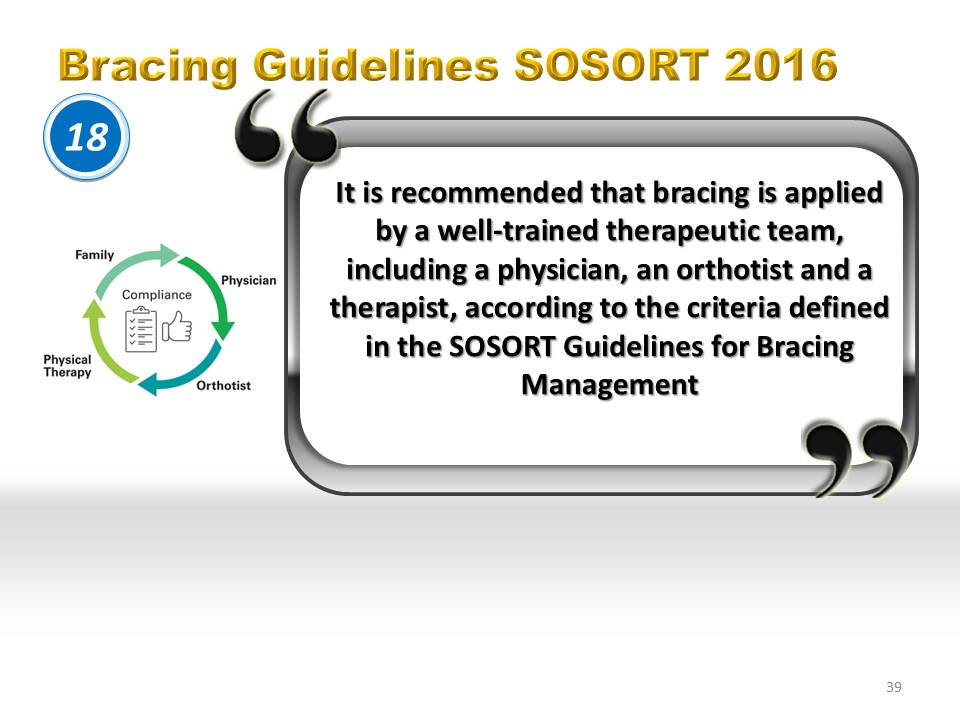 |
When everyone involved in conservative treatment management communicates effectively and collaborates seamlessly, patient compliance is significantly enhanced. In the process of shaping in the corrected position, the ortho-prosthetist has the opportunity to build upon the corrections already implemented by the physiotherapist, ensuring a cohesive and efficient treatment approach.
|
 |
Each stage involved in the creation of braces is distinct, and it is most effective when executed by the same Certified Prosthetist and Orthotist (CPO). The International Society on Scoliosis Orthopaedic and Rehabilitation Treatment (SOSORT) has established a comprehensive protocol for standard evaluations.
|
 |
Although protocols often differ as they are tailored to local circumstances, achieving an agreement on the overarching principles of conservative treatment is generally feasible. This checklist delineates these fundamental guidelines. However, the diversity in protocols poses a challenge when attempting to compare them comprehensively over an extended period.
|
 |
The brace design must adapt to the curve(s), taking into account the 3 planes of space. For the Lyon Method, it's the number of main curves that's essential to the design. The geometry of the trunk model is also important.
|
 |
Effectively managing the sagittal plane plays a crucial role, as it has a more significant impact on the progression of scoliosis into adulthood than the frontal plane does. Within the framework of the Lyon Method, which incorporates coordinated movements in both the frontal and sagittal planes, this management is inherently included in the corrective process. The main challenge lies in harmonizing the translation along the Z axis while simultaneously preserving the curvatures within the sagittal plane.
|
 |
The delicate balance between achieving curve correction and ensuring brace comfort is central to the ultimate outcome. The underlying principle of the Lyon Method is to view the brace as a guiding mechanism that steers the torso counter to the direction of the scoliosis curve. The nature of contact varies depending on whether one is standing, seated, or lying down.
|
 |
The ventilatory function should remain largely unaffected by the use of a brace. When considering the lumbar region, selecting a brace that allows for a natural lordotic posture ensures optimal abdominal breathing. In the upper thoracic area, the flexible nature of polyamide material aids in promoting efficient breathing. To enhance this, one can simply loosen the upper Velcro strap.
|
 |
The process of correcting scoliosis with a plaster cast brace necessitated a stay in the hospital. Half a century ago, patients remained hospitalized for the entire duration of their casting, as educational facilities were established within the hospital premises. In France and throughout Europe, significant scoliosis treatment centers began to emerge. Physiotherapists who participated in the creation of these casts took the opportunity to enhance their techniques, one notable advancement being the development and implementation of the Lyon Method.
|
 |
The renewal of a brace is contingent upon the individual's growth in stature and the frequency with which the brace is worn. Upon reaching the conclusion of growth in height, it is imperative to consider the remaining development of the rib cage. The brace serves to stiffen the spine, and it is commonly observed that there is not only a decrease in the reduction achieved by the brace but also a decline in spinal elasticity, which is deemed beneficial.
|
 |
Typically, the brace is replaced annually. This systematic approach to renewal allows for a reduction in the frequency of X-rays to just two per year: one taken while the brace is being renewed, and the other during an interim check-up without the brace.
|
 |
We appreciate your interest and would like to remind you not to overlook the second installment, which delves into physiotherapy and sports.
|
|
|
To register for Certification, please contact SSOL
|