Uncategorised
- Details
- Written by: Jean Claude de Mauroy
- Category: Uncategorised
- Published:
- Hits: 0 3743
Review of mechanical characteristics and properties of braces
(F. Barral, CPO, DIU d’appareillage du rachis, Scientific committe group Proteor-Lecante, University Lyon I,University J.Monnet, Saint-Etienne)
FOREWORD: Why this review?
✓ There is a wide variety of braces around the world, each team developing their own technique from available means and materials.
The mistake has long been to want to treat each scoliosis with the same type of brace. This created partisan discussions and “parochial disputes”. Today, the association of different methods increases the chances of successful treatment.
✓ Old designed braces are still used today, for their specific properties. No pre-eminence of a « champion » that would have made them
outdated.
✓ The SOSORT classification only knows those that have been the subject of scientific papers (Scoliosis). For example, the Garchois brace, the 3D from Saint-Etienne, the 4 points, are not known.
✓ The main indicator of good results, Cobb angle, is set to change because obsolete and unsuitable.
✓ The existence of schools (Lyon, Chêneau, etc…) is essential for teaching, as learning this job is complex, without a real reference book for CPO. The practical aspect is very important but rarely complete, and reaching an expert-level takes many years of practice.
✓ One important subject has to be treated: remuneration and ethics.
1. State of the art: the different braces, in 4 groups
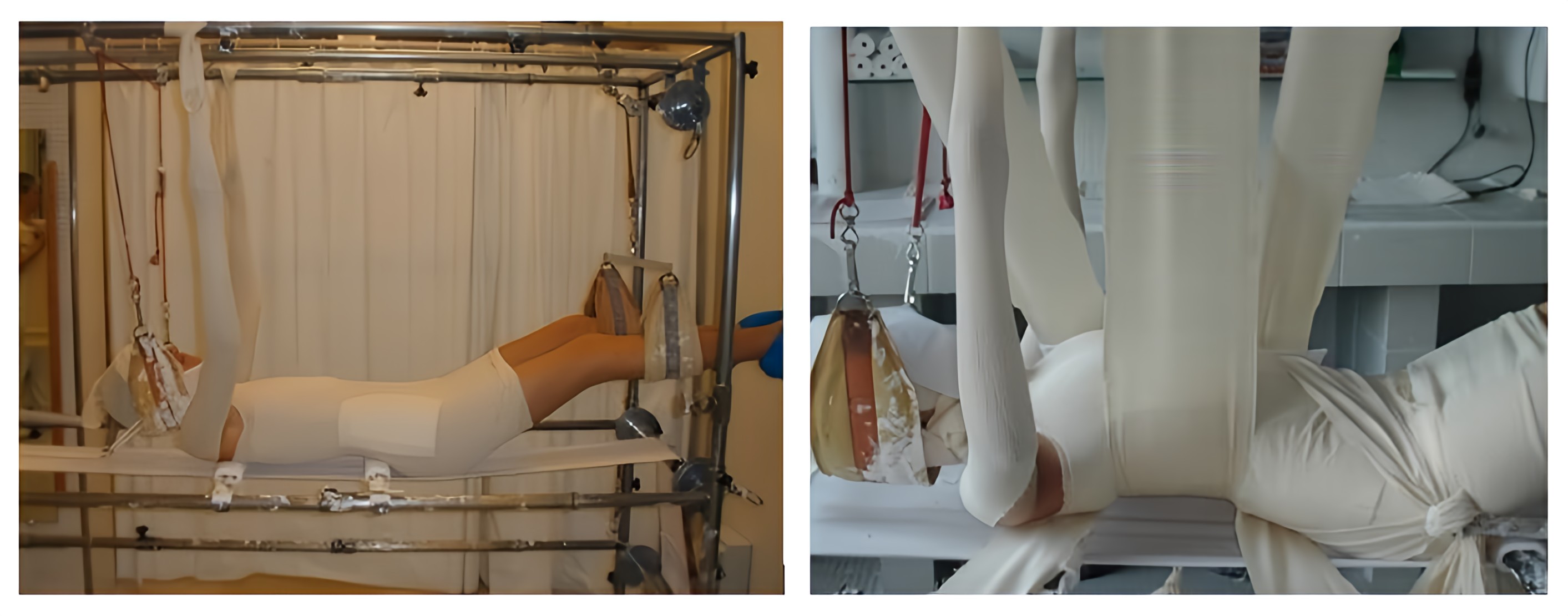
a. Plaster brace E.D.F. (Elongation, Dérotation, Flexion)
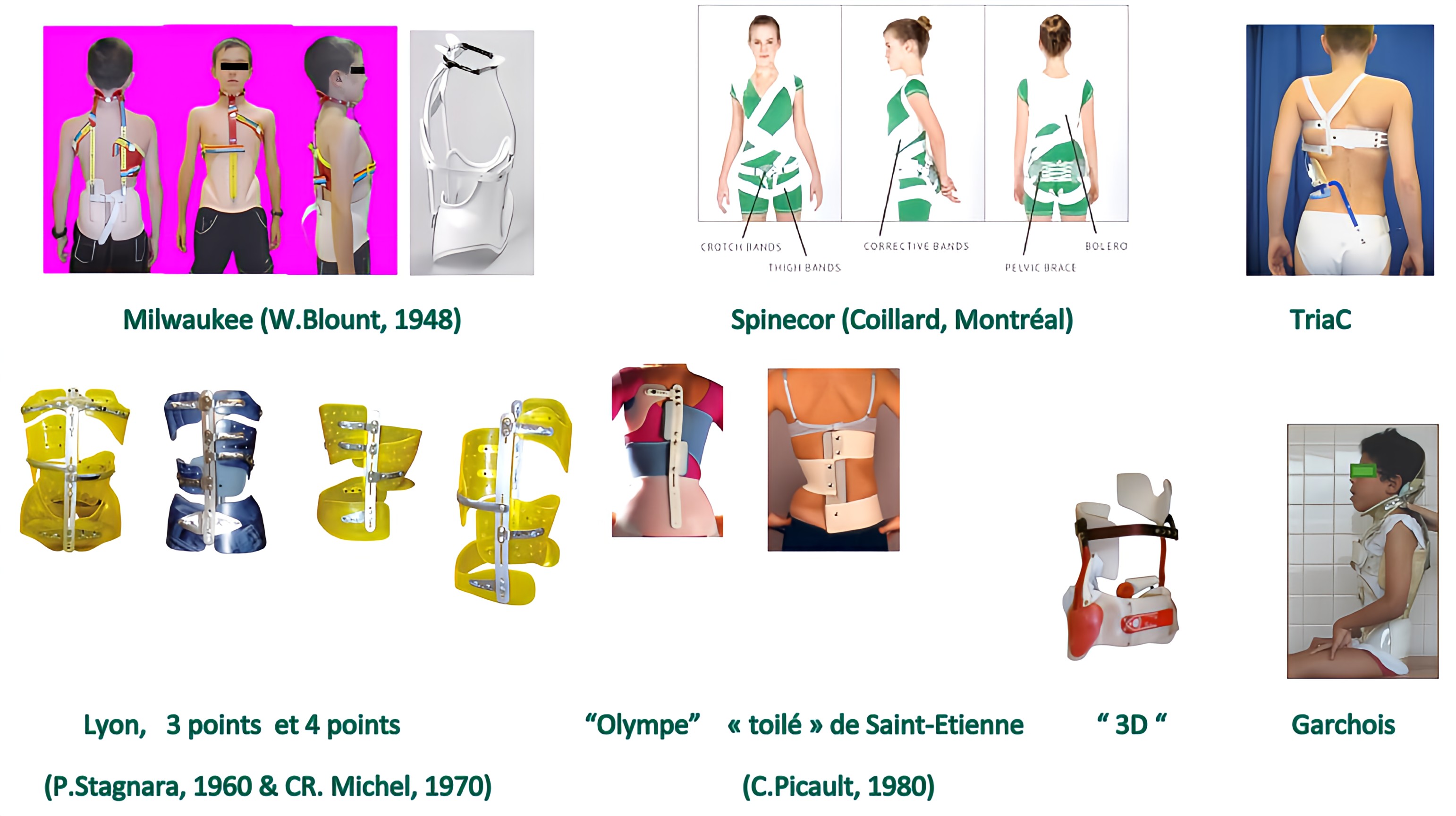
b. Adjustable braces
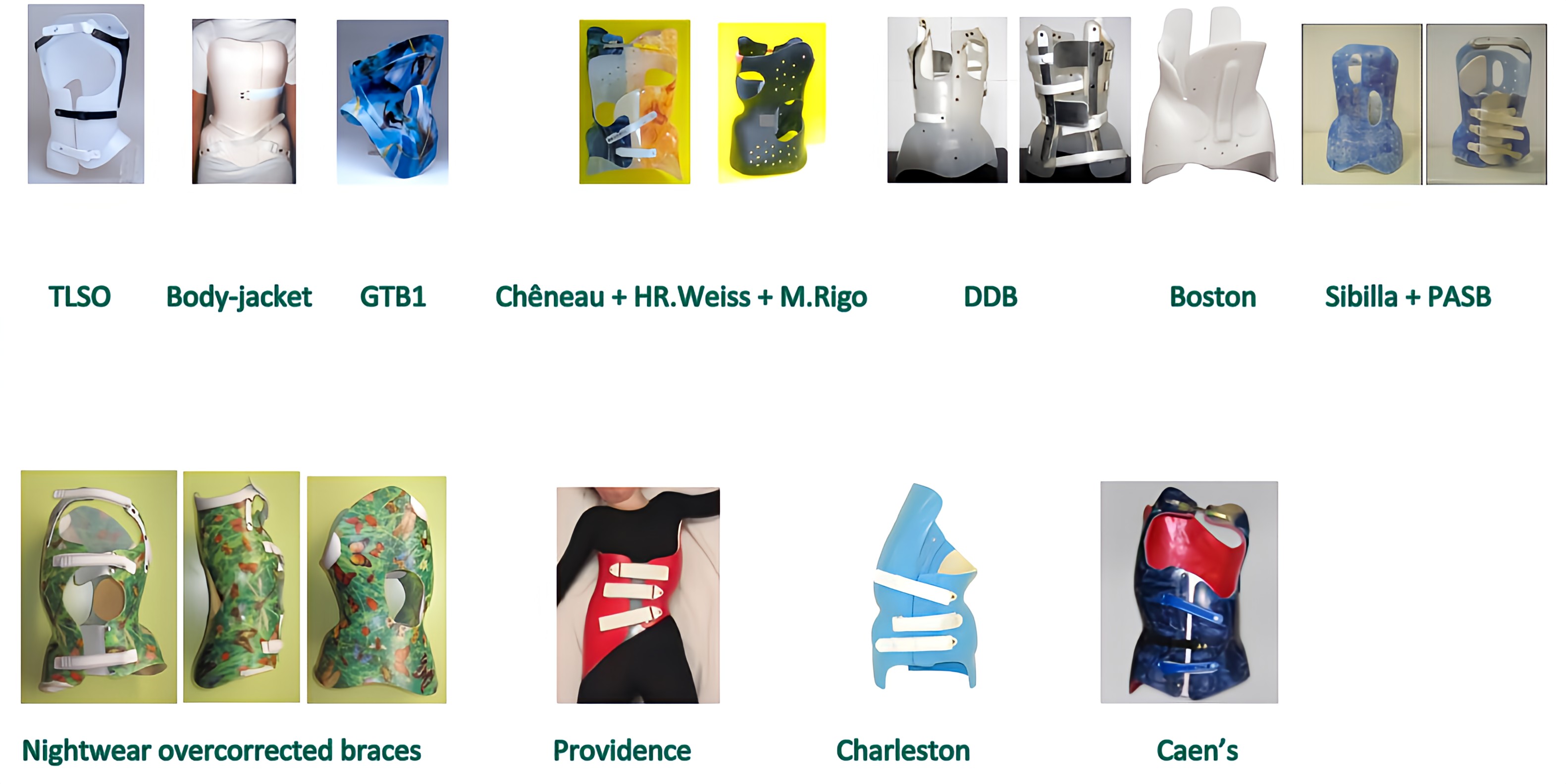
c. Monoshell braces :
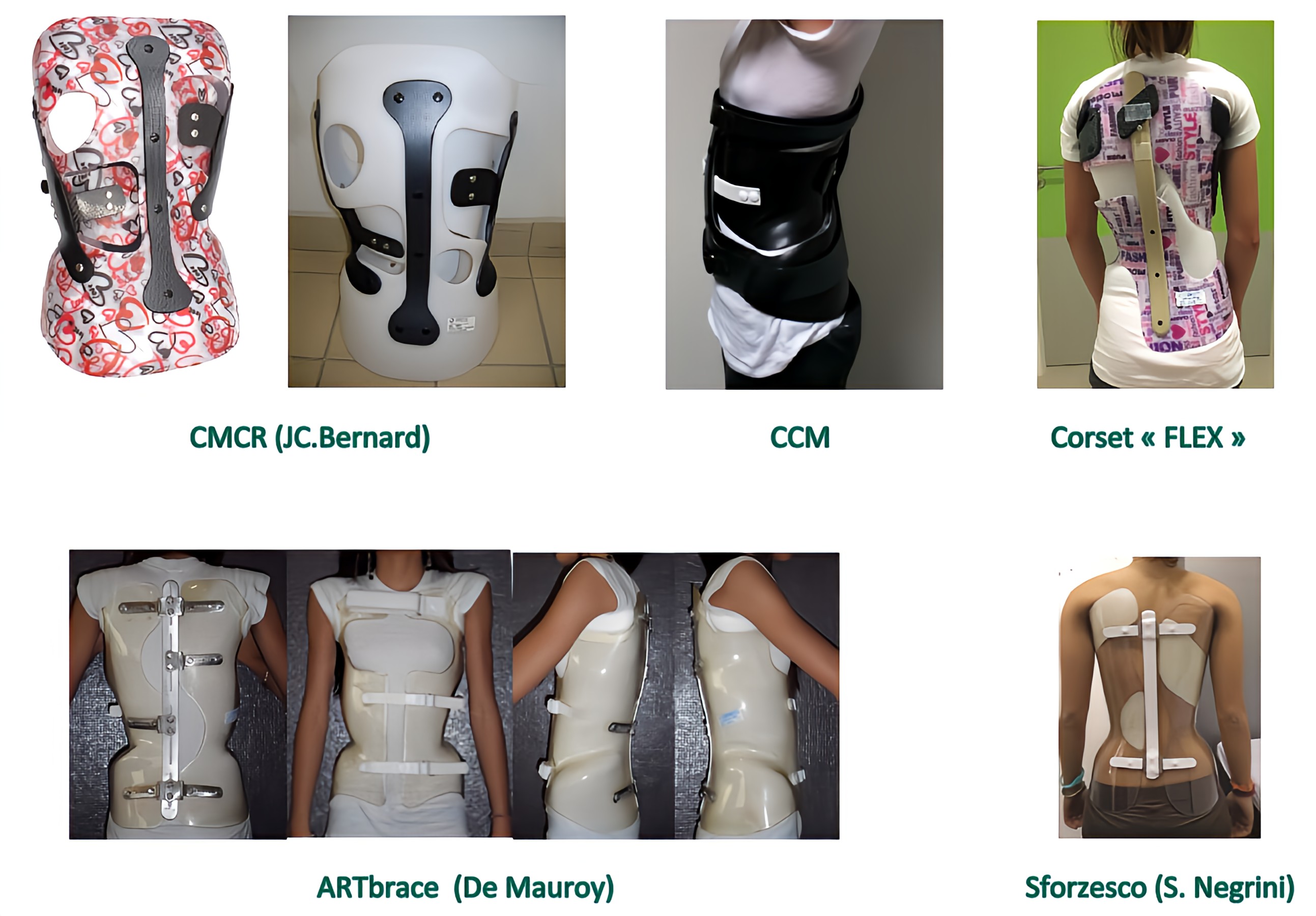
d. Mixed braces :
2. REMINDER : Treatment action objectives
Hueter-Volkmann law :
- nucleus refocusing
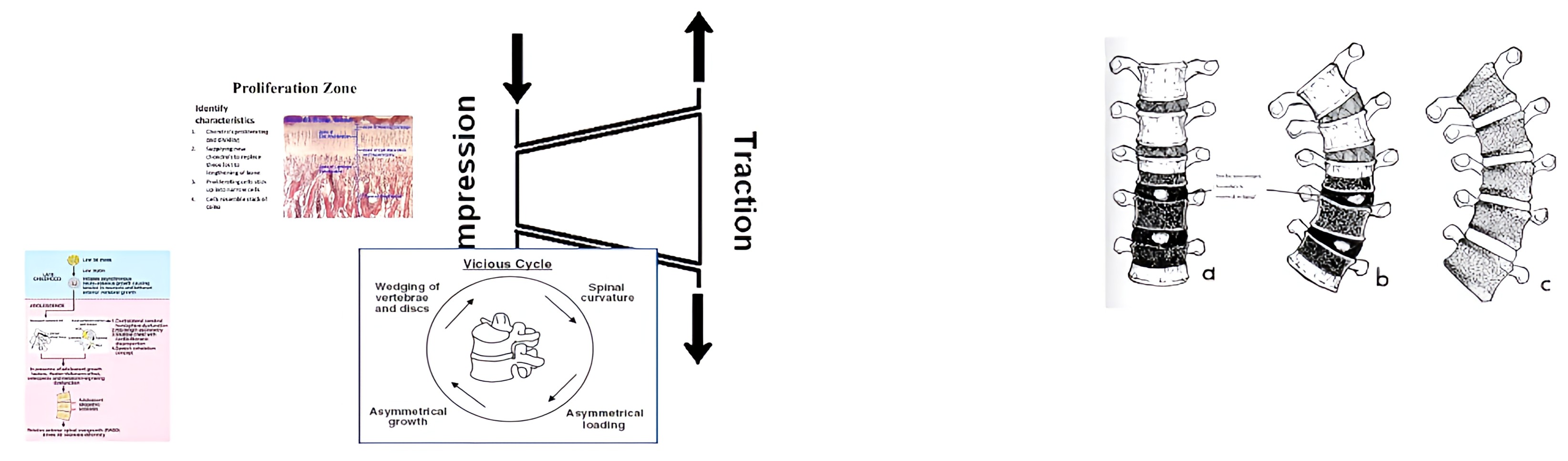
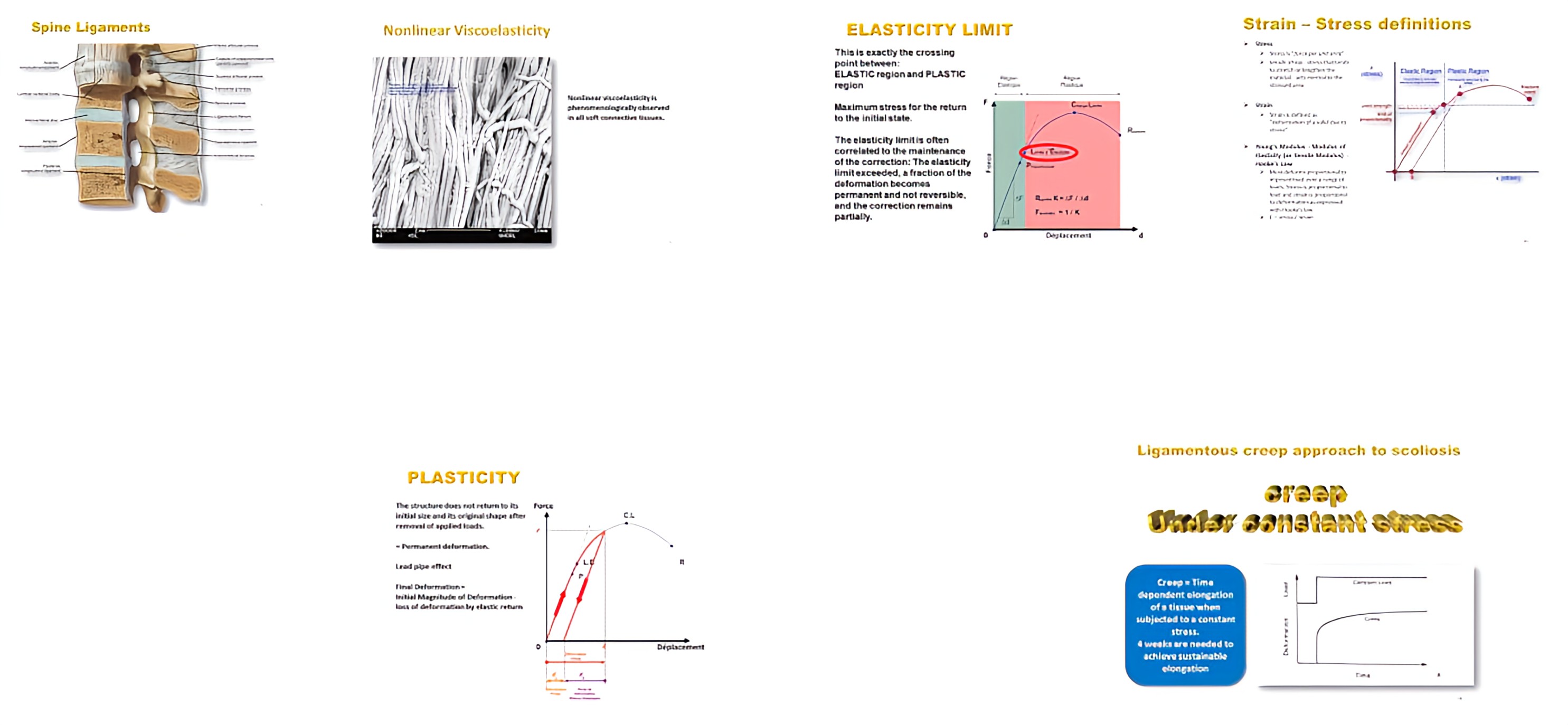
-Ligamentous creep : according to some authors, only permanent traction for 3 weeks allows permanent modification of ligaments length
-Coupled movements : Harrison Fryette (1918)+ Panjabi
3. PROPERTIES and MECHANICAL ACTIONS of ORTHESES : external actions – internal effects
3.1 Active or passive axial distraction
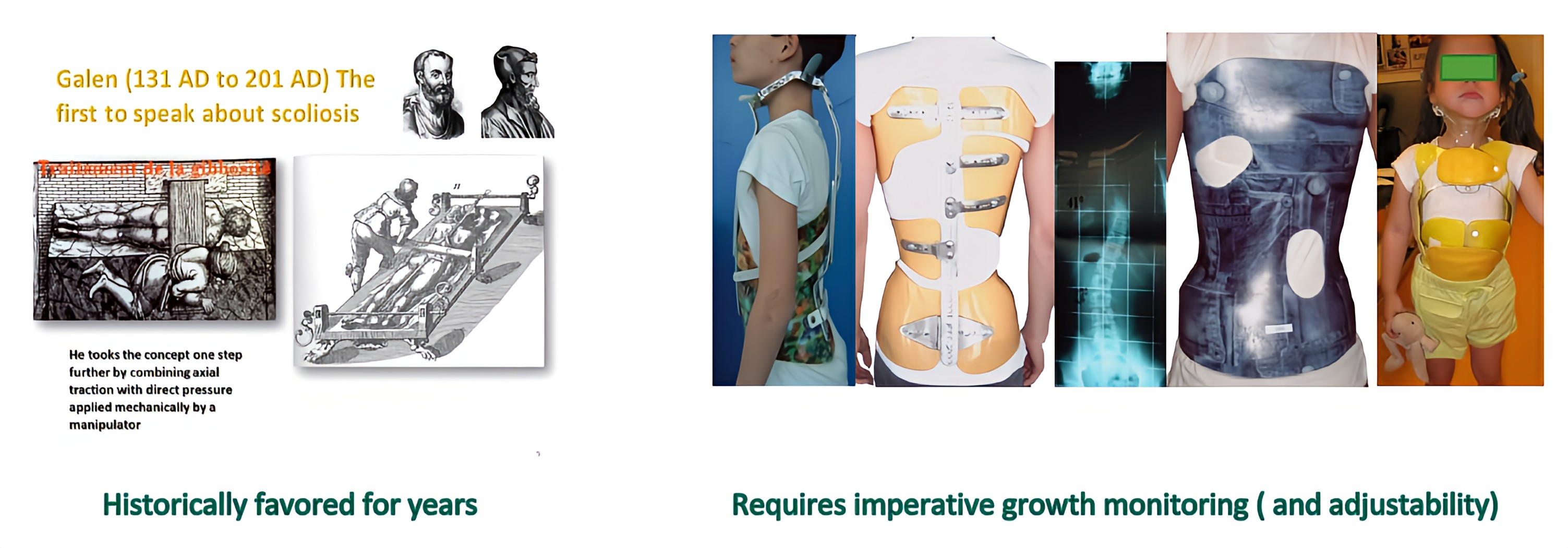
3.2 Segmental translation ( progressivity if settings) :
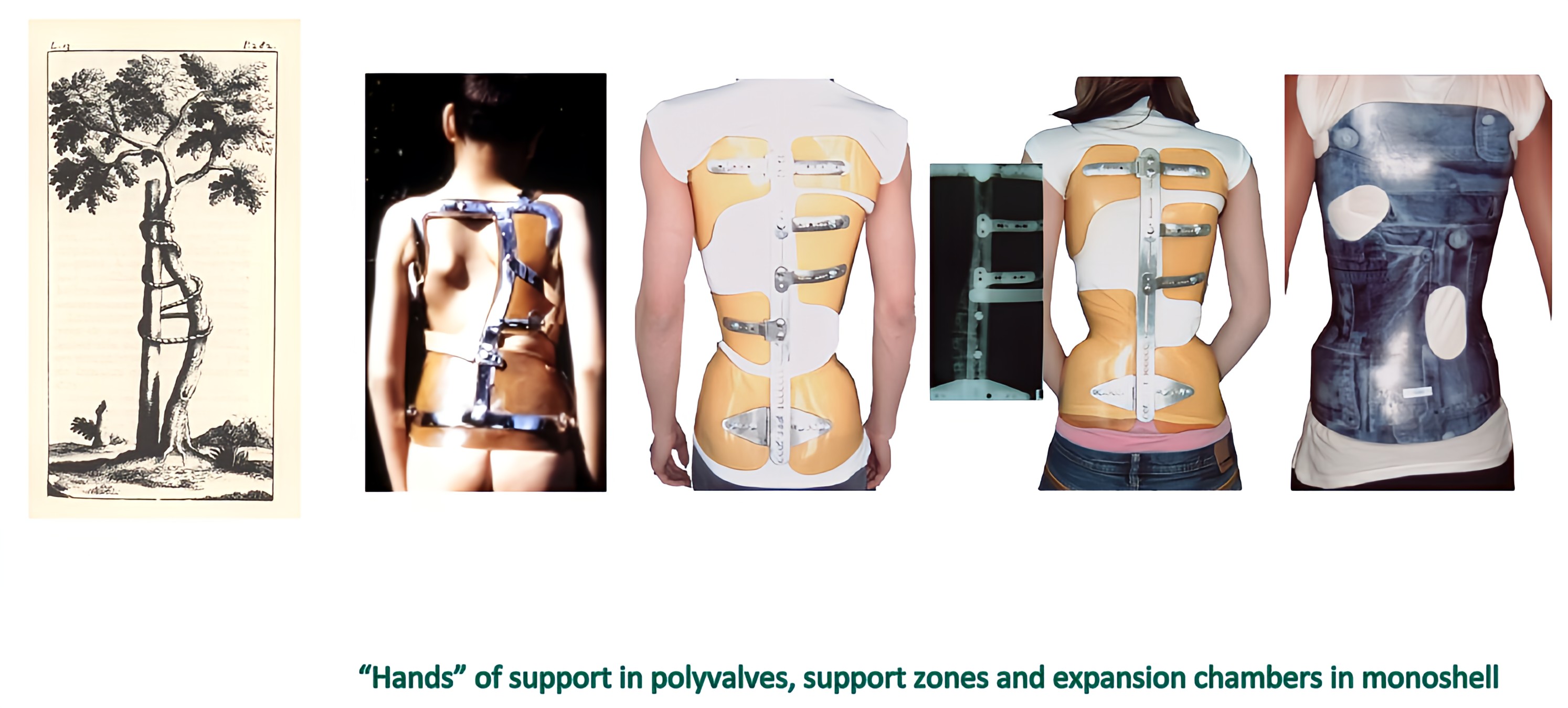
3.3 Lumbar level : shift + lordosis = derotation
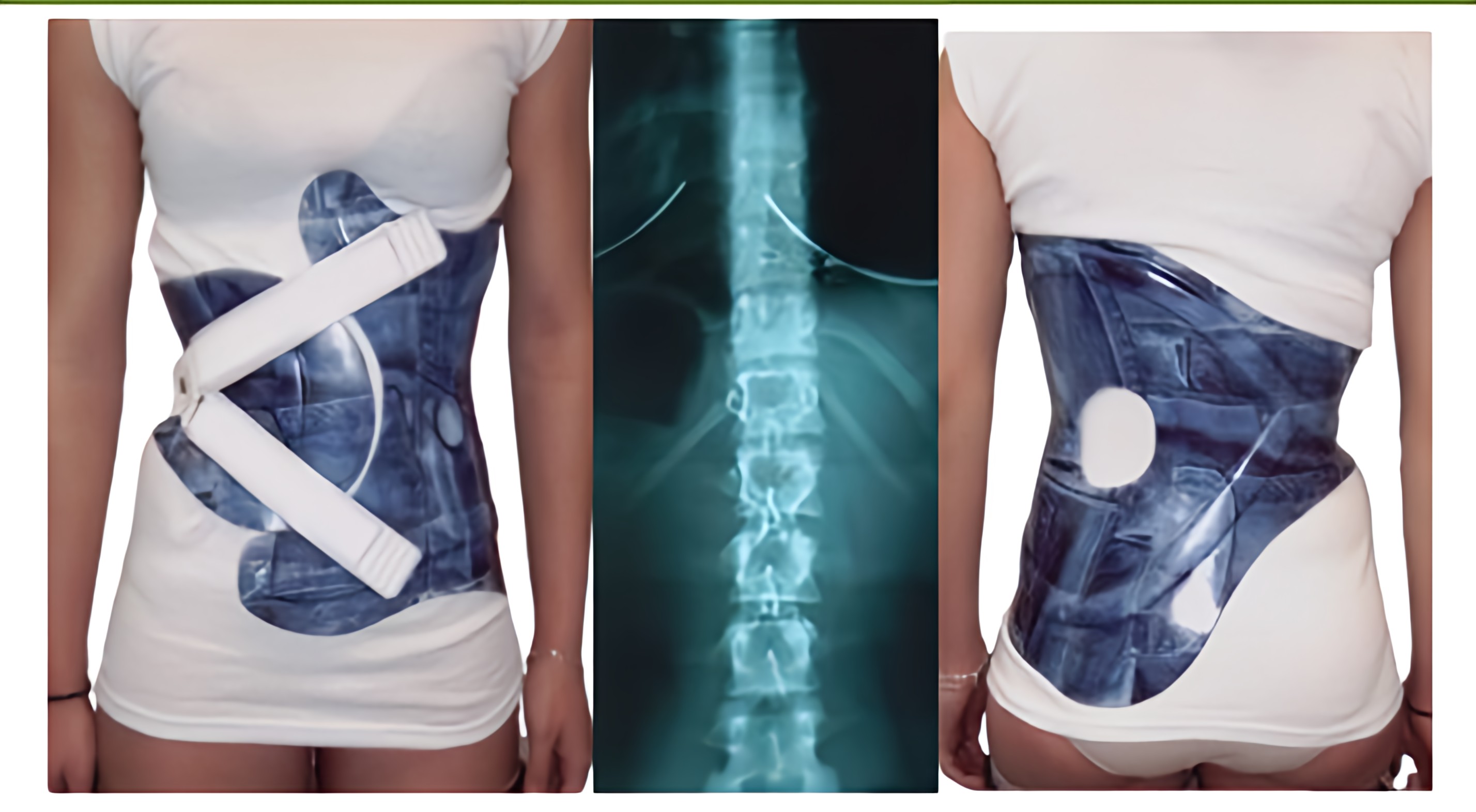
3.4 Opening the ilio-lumbar angle
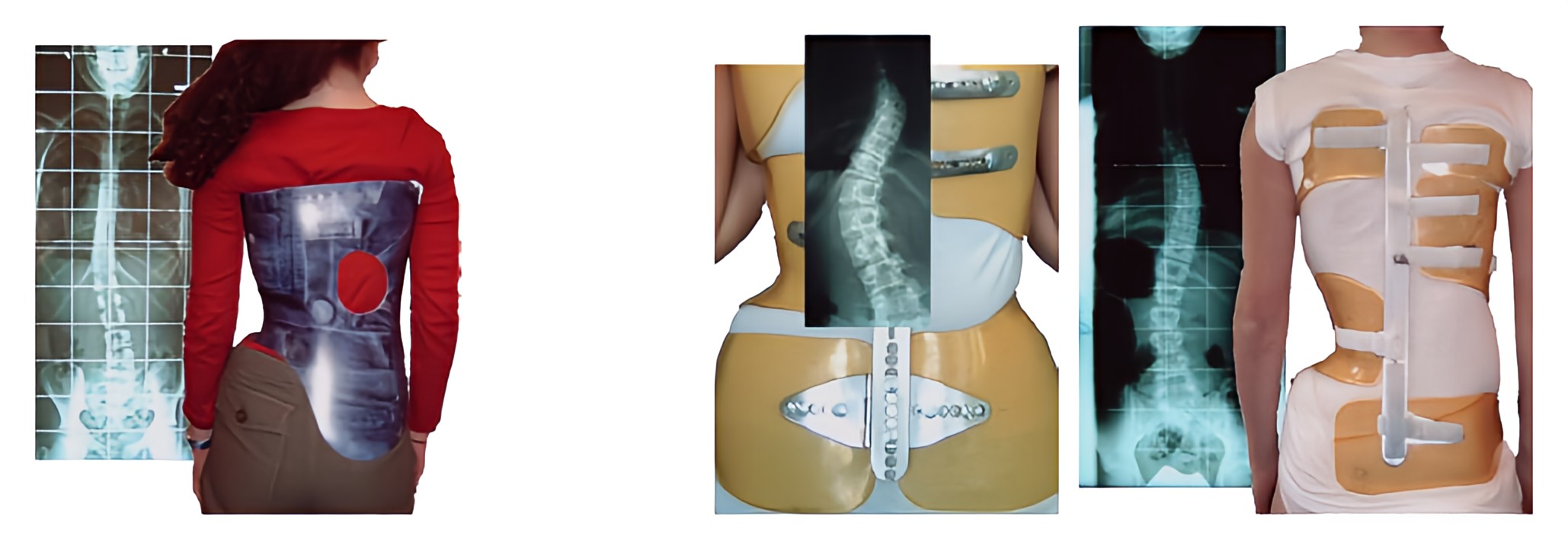
3.5 Thoracic level, hump modeling
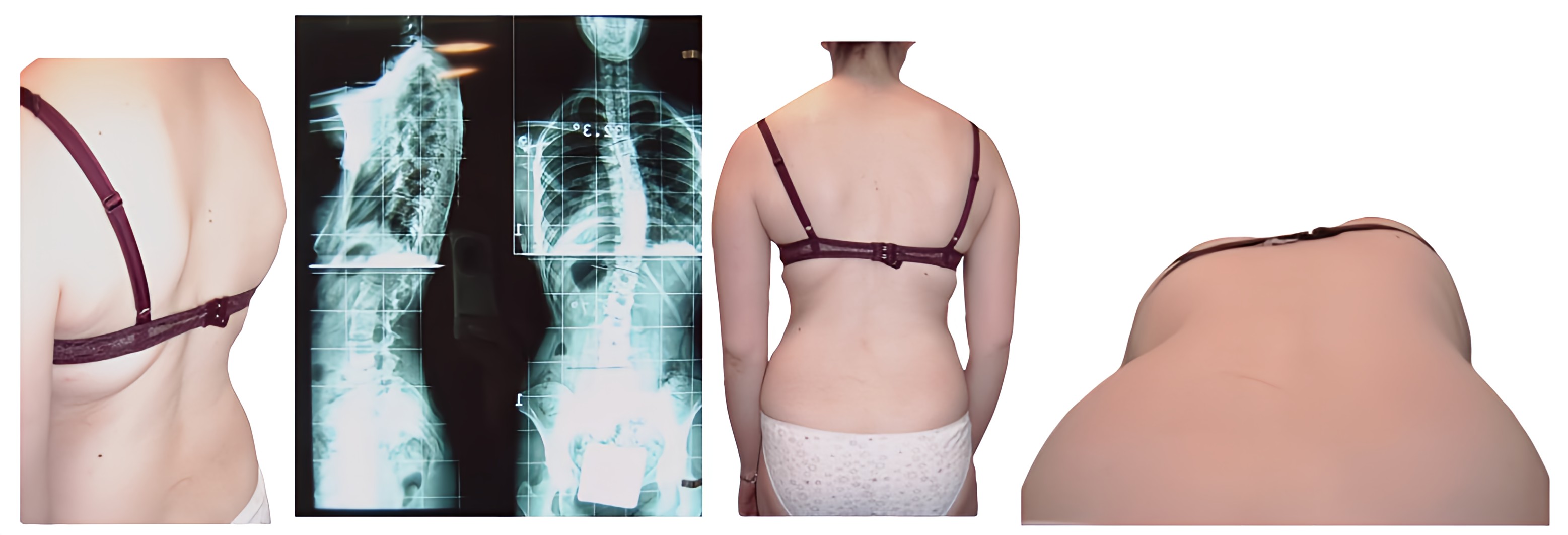
3.6 Kyphosis research
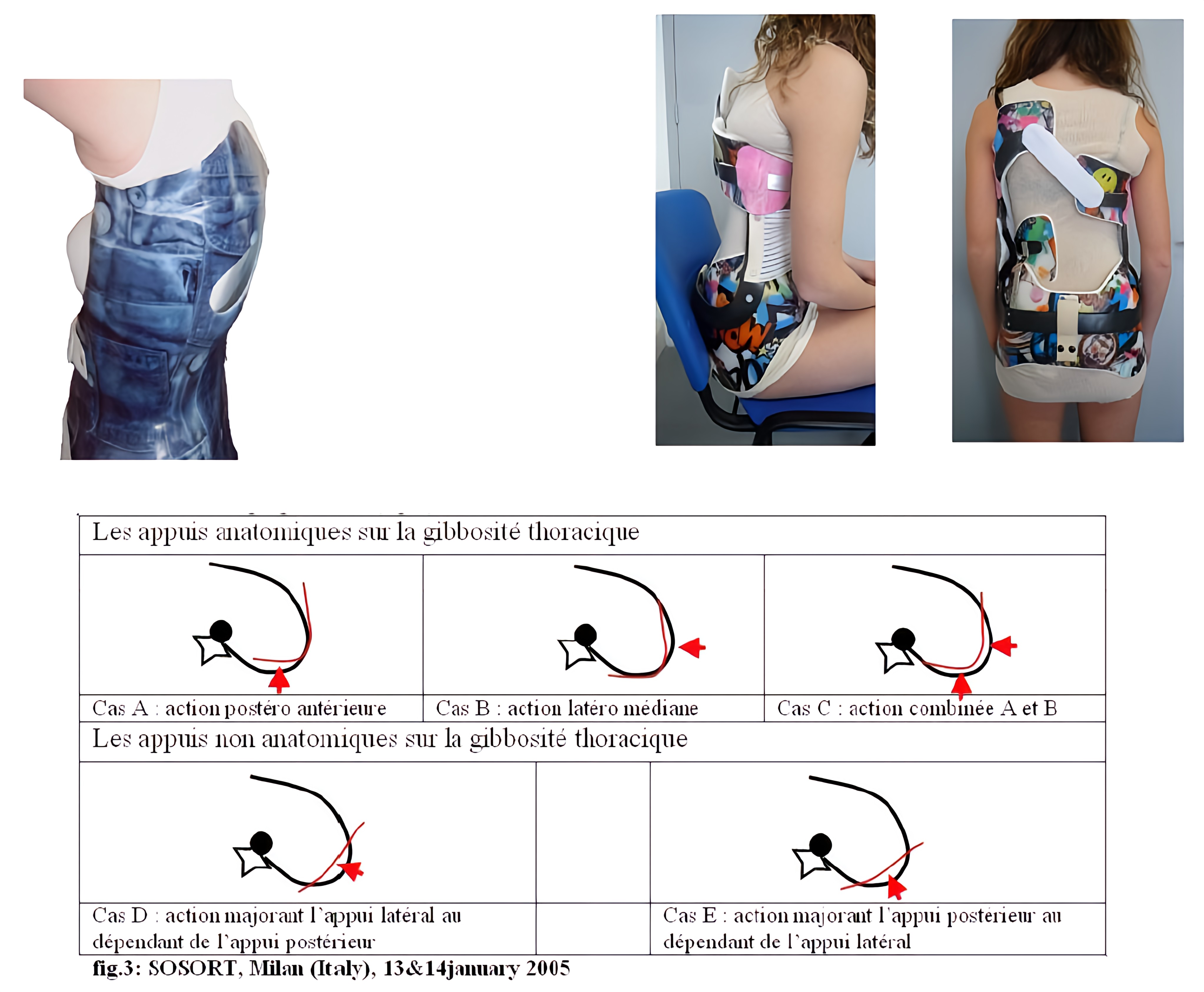
3.7 Bendings
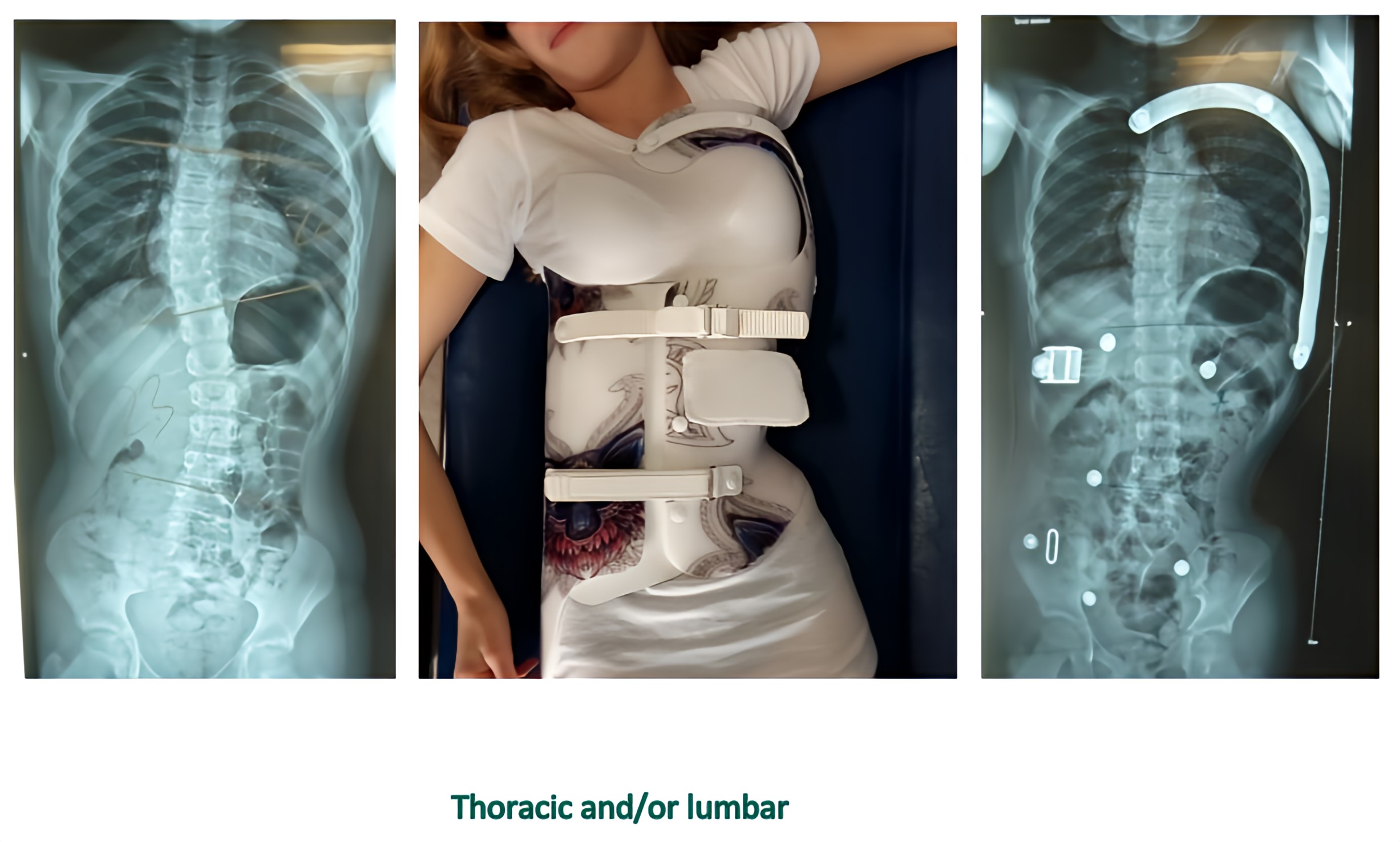
3.8 Re-balancing by asymmetric cutlines
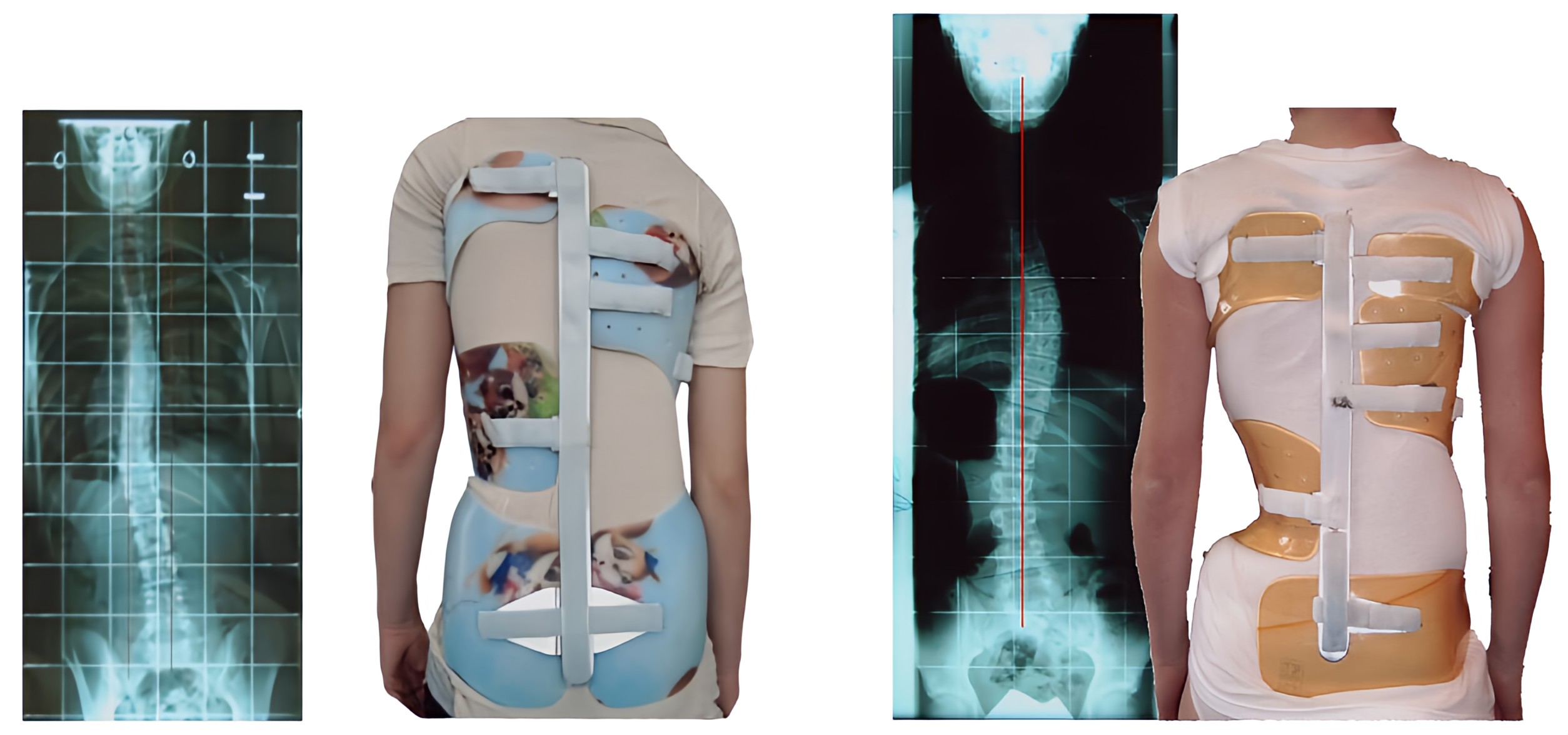
3.9 Positional re-balancing (postural part of the curves)
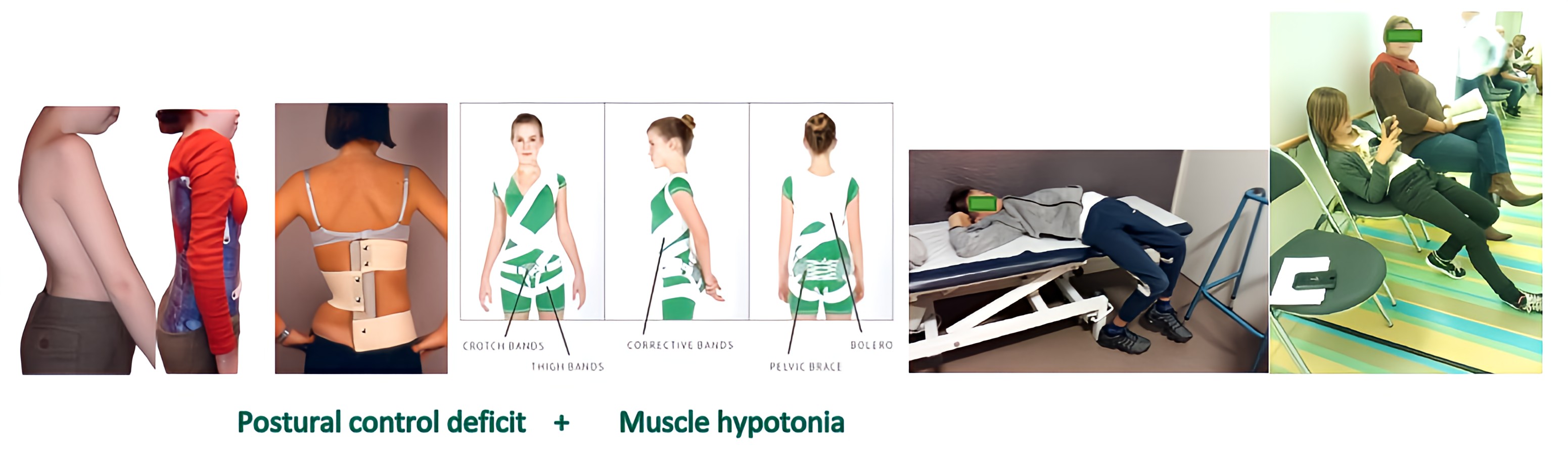
3.10 Segmental twist + high rigidity + axial distraction (baby lift)
The different levels can untwist while sliding inside, thanks to the material and the interface.
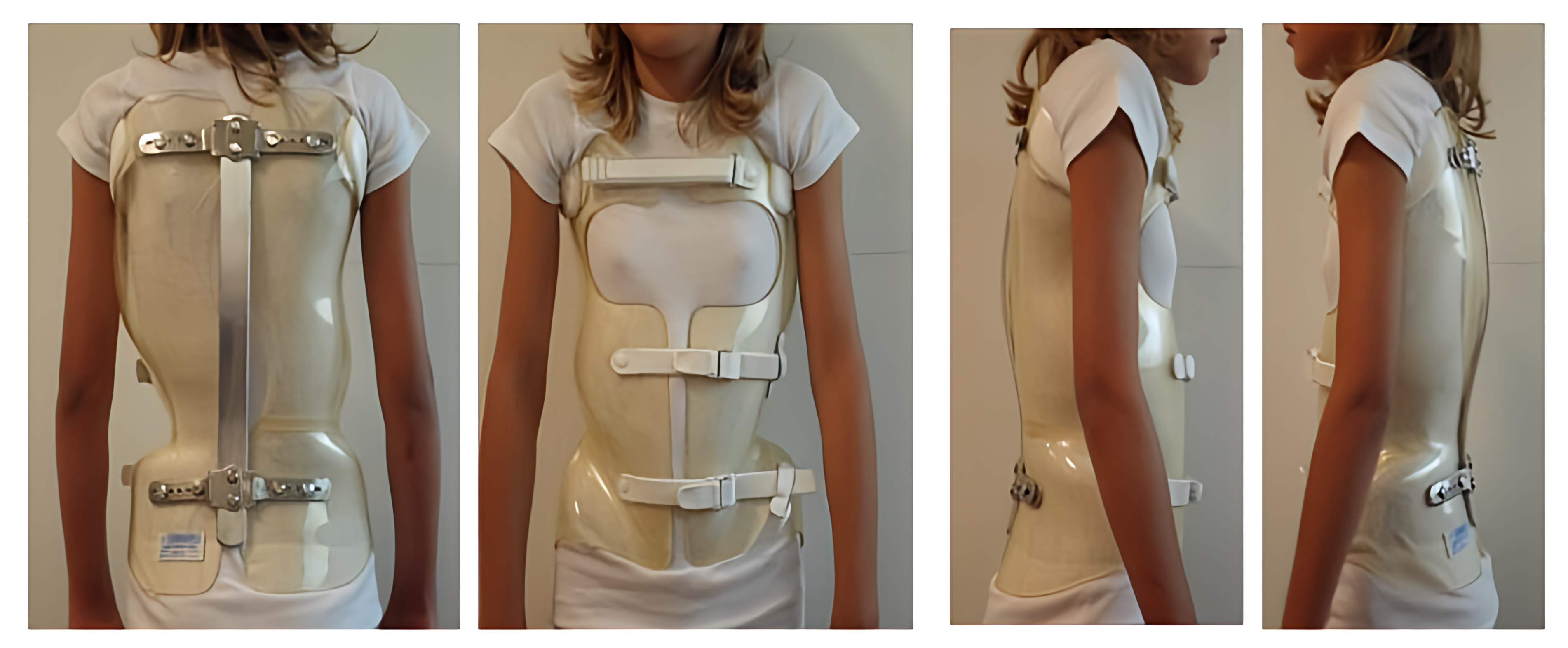
3.11 Respect of vital capacity and thoracic growth
Rigid supports of the Lyonbrace become dynamic, thanks to carbon blades, and still ajustable.
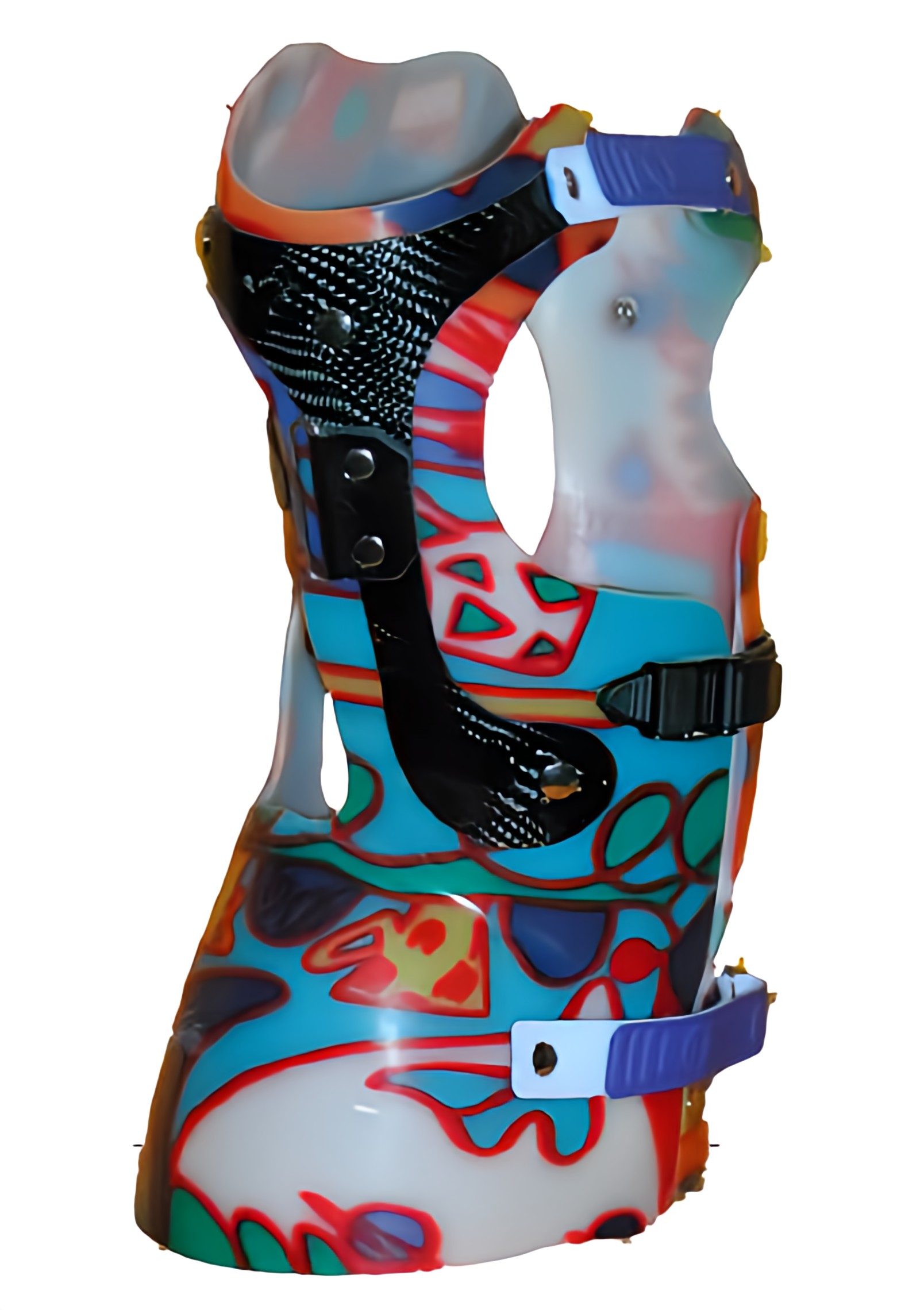
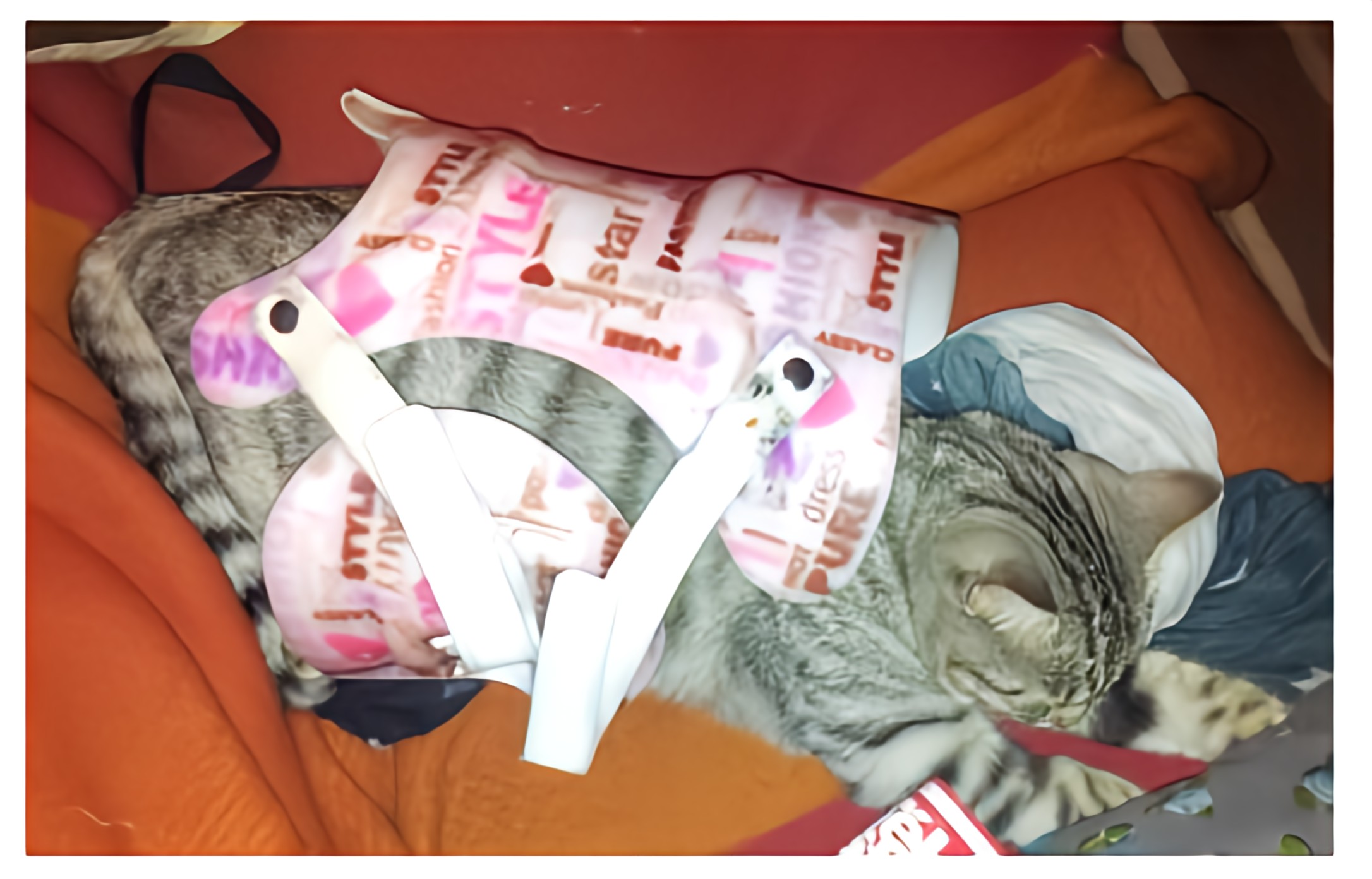
3.12 Comfort (no child will accepts to wear a brace that hurts)
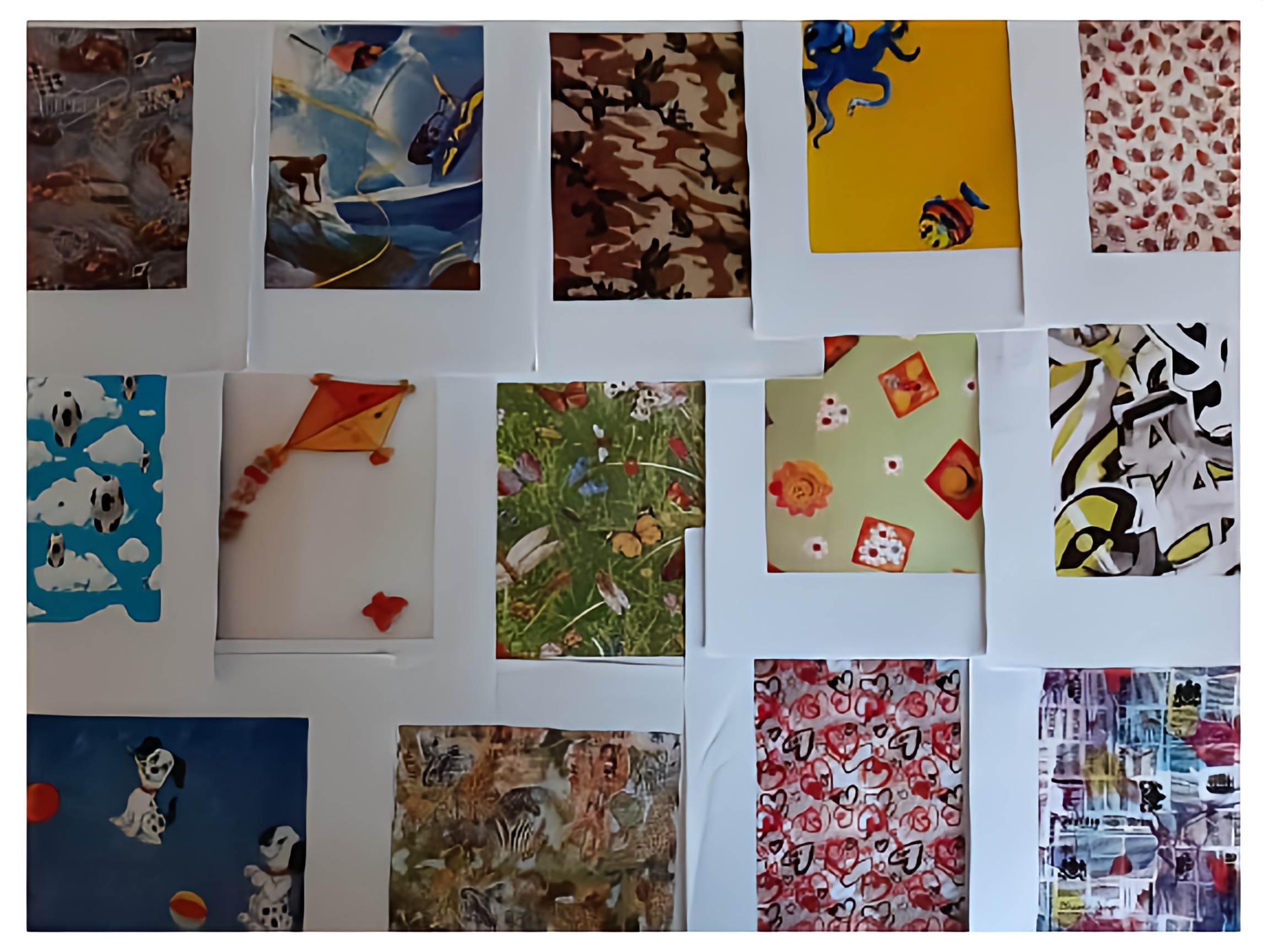
3.13 Aesthetic : the ability to choose improves appropriation
EACH OF THESE PROPERTIES MAY BE NECESSARY
NO BRACE HAS ALL THESE PROPERTIES
4. IN PRACTICE : from assessment to orthesis
✓ Age (infantiles, juveniles, adolescents)
✓ Clinical aspect: humps, imbalances, oblical departures, etc…
✓ Topographic localisation of the curves
✓ Importance of the curvature (Cobb)
✓ Rigidity vs reductibility
✓ Sagittal plane (flat back)
✓ Complications ( neurological, cardio-respiratory, connective disorders, obesity, etc…)
✓ Psychological aspects (acceptance, appropriation). Compliance.
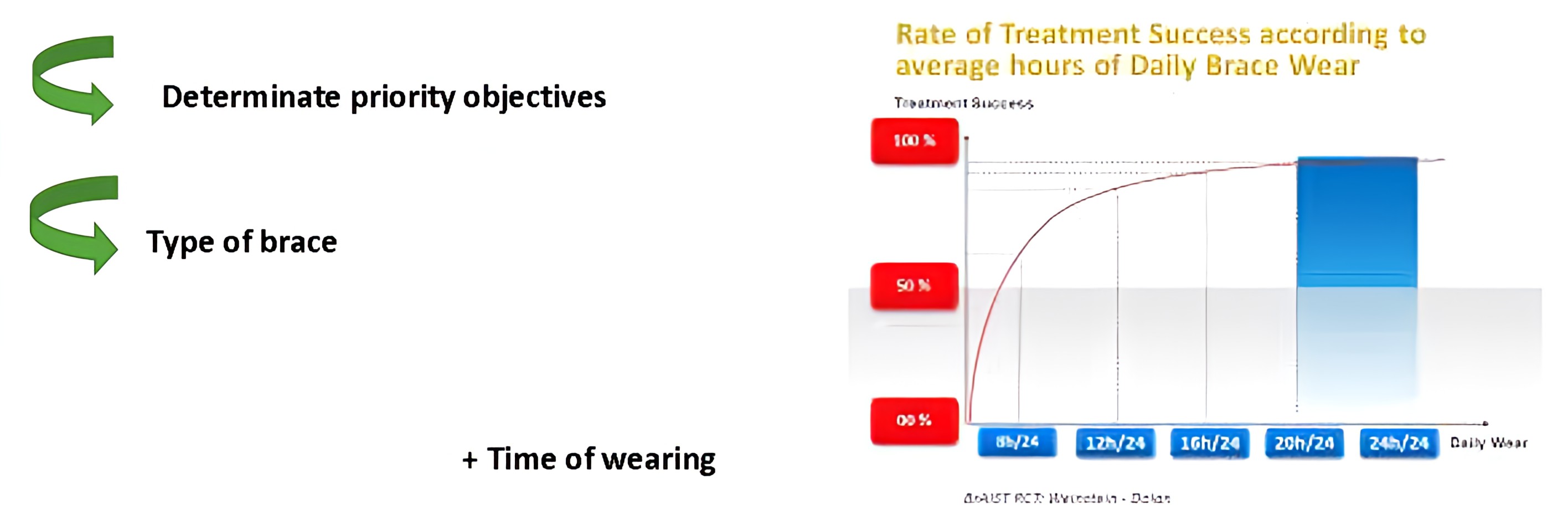
5. DISCUSSION :
Limits may exist : economic, technical, know-how. Not everyone has access to the most sophisticated tools.
« Schools » are necessary to learn, but often dogmatic and therefore limiting : should we still make Milwaukee braces with leather belts today to remain faithfull to W.Blount and claim his good results, statistically significant ?
Cobb angle is today unsuitable and outdated. The “top view” will be a better tool in the future.
Limits of conservative orthopédic treatment : for example here, very little internal effect (Ehlers – Danlos syndrome)
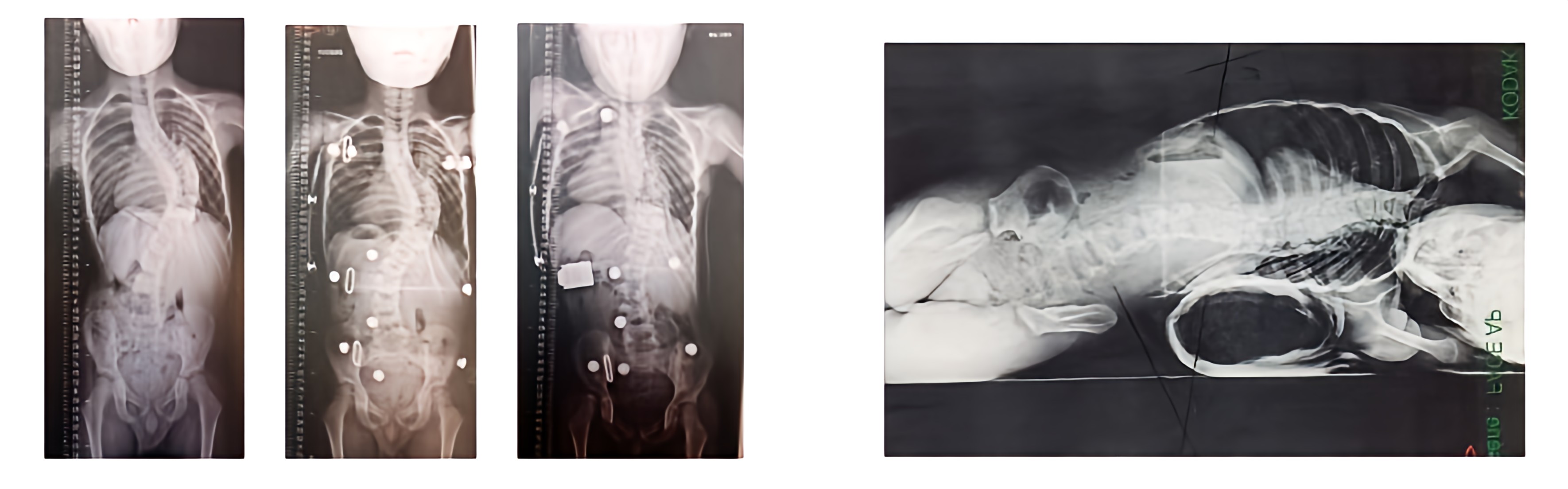
What fair remuneration for our braces ?
Do we have to validate and pay for this useless work ?
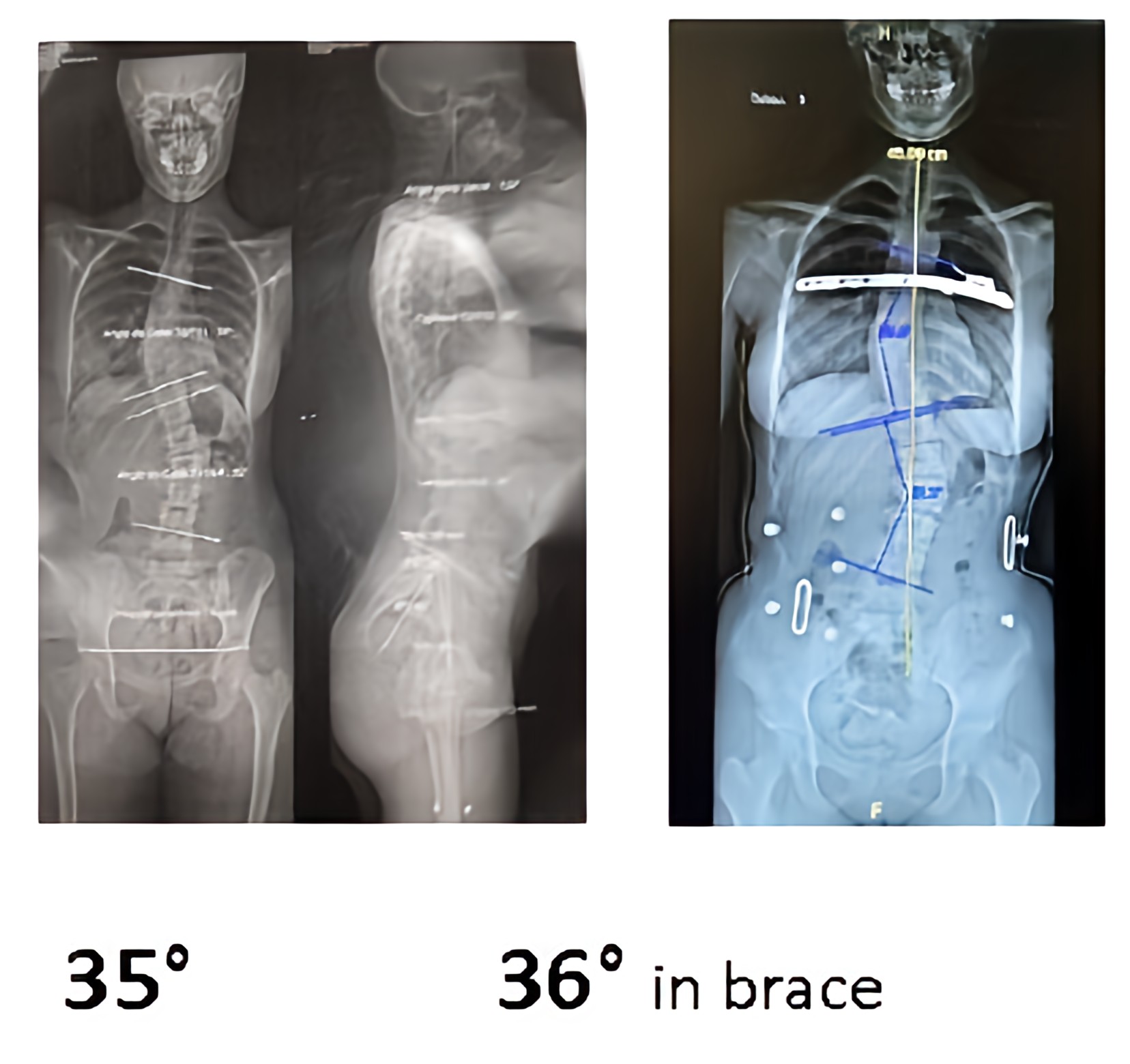
Or this one, increasing flat back ?
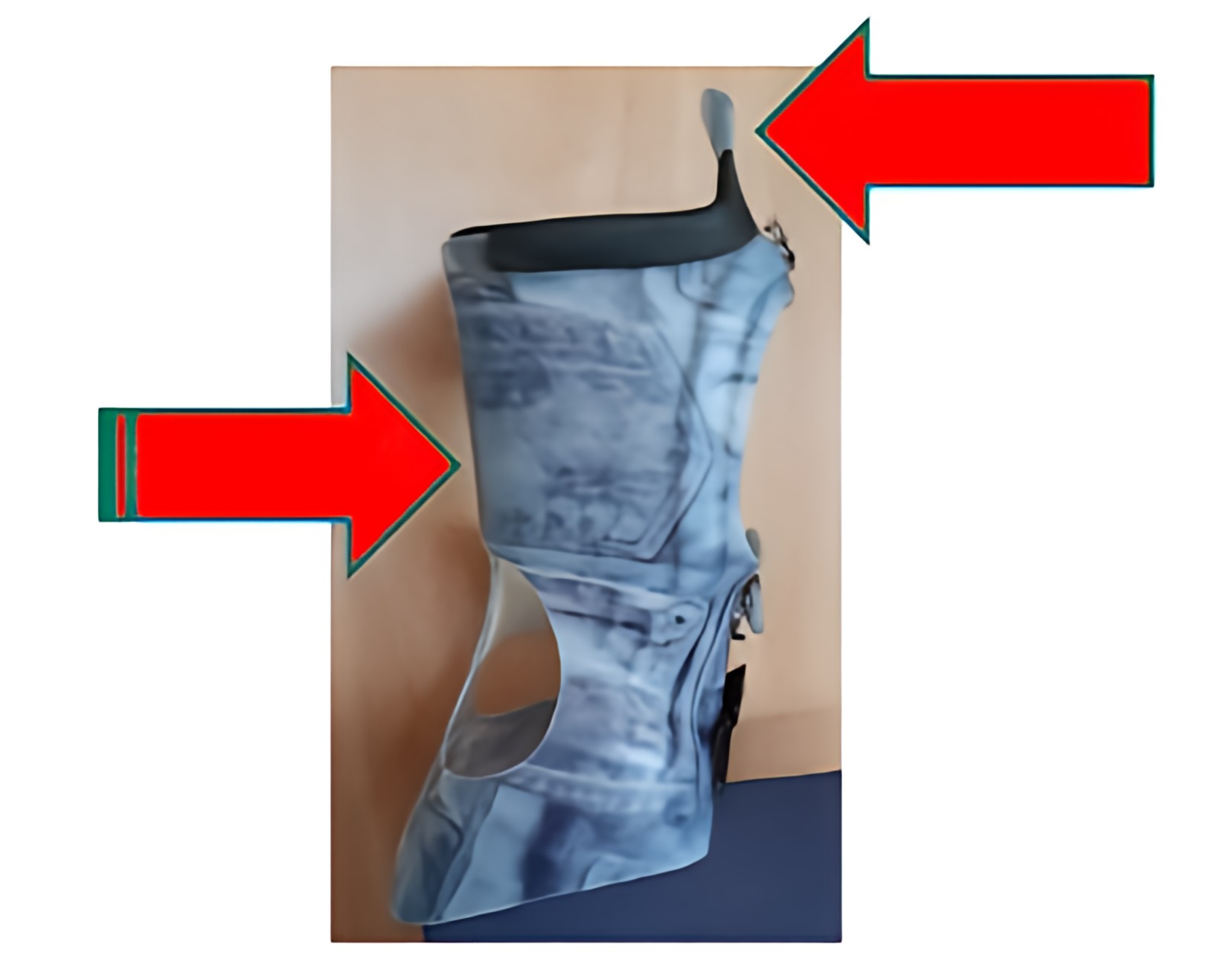
Regulation is essential.
6. CONCLUSION
The specific characteristics of each brace can be referenced. We could imagine a few basic braces, with an arsenal of possible variants and additions, to adress the priorities of each patient.
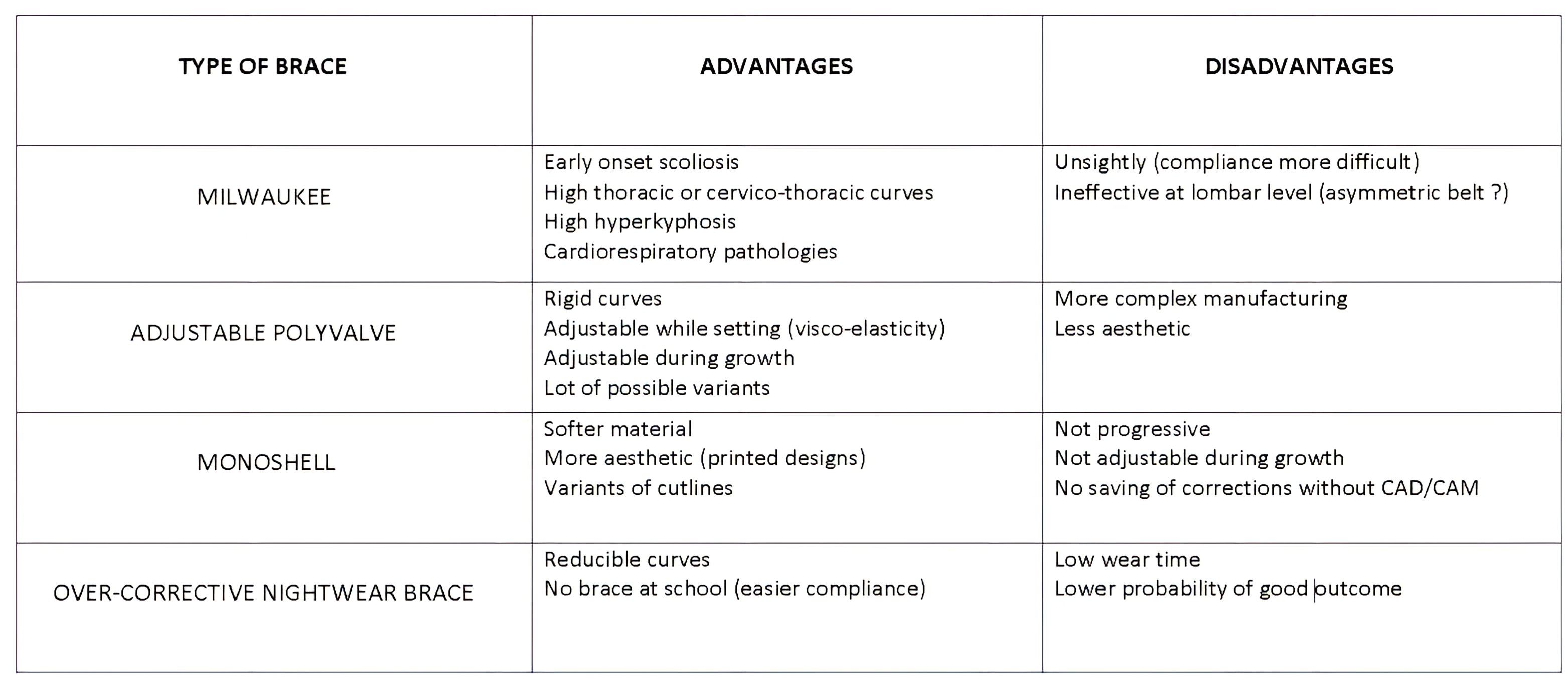
The Evidence Based Medicine leaves considerable room for practitioner’s experience.
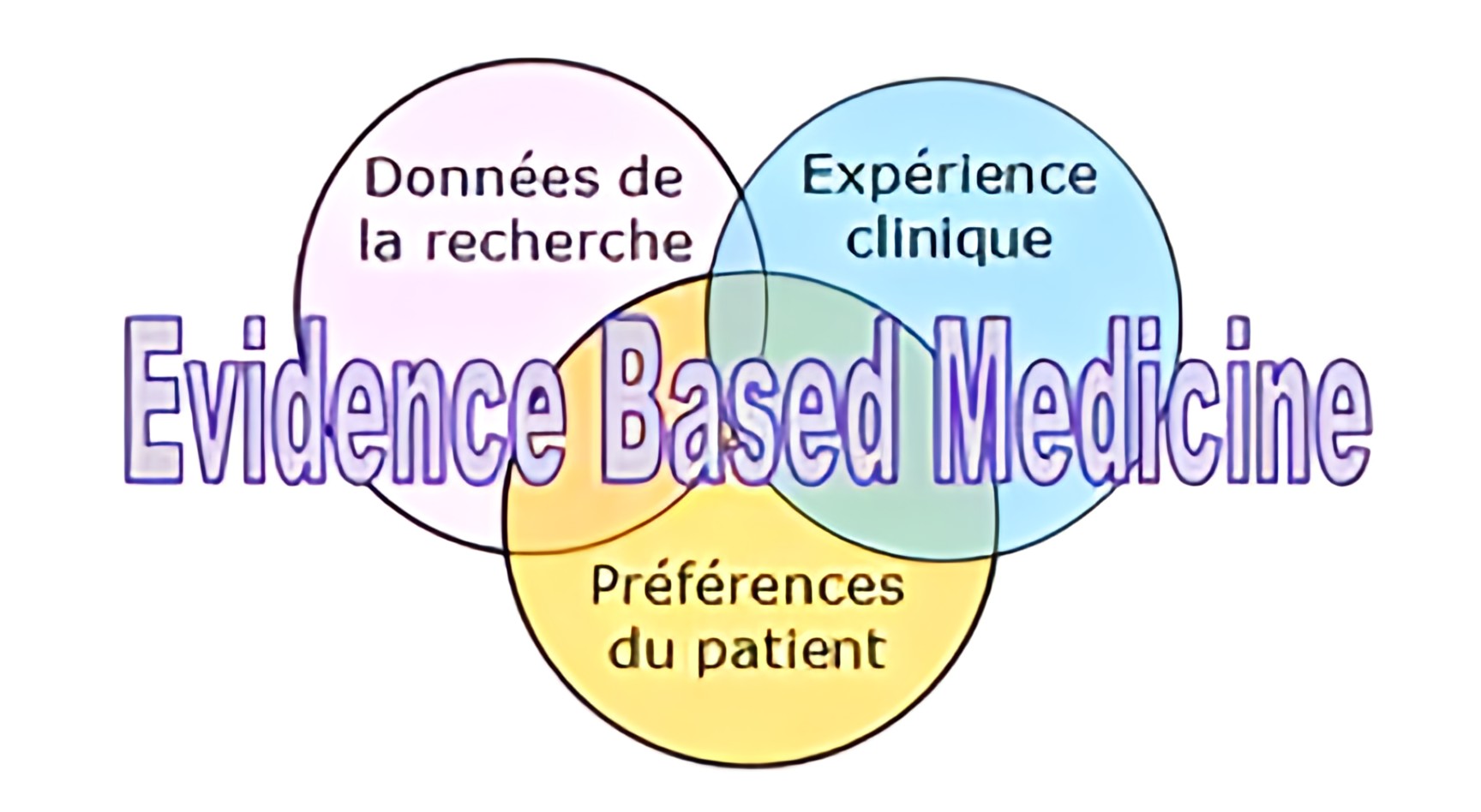
Once he masters this wide range of possibilities, the practicioner-expert can design and realise braces « à la carte », like a mosaïc. The aim is to propose to each patient the best brace for their case, whatever its name (Brace « with no name ») .
This review is not complete, it is the foundation for future reflections and work. It is the CPO’s « point of view ». Teaching and passing on the experience remain the fundamental challenge.
The scientific approach (SOSORT) is precious and essential. The clinical practice is paramount.
An ethical and regulatory approach is necessary and still needs to be done.
7. REFERENCES, BIBLIOGRAPHY :
F. Zaïna, JC. De Mauroy, T.Grivas, MT. Hresko, T. Kotwicki, T. Maruyama, N. Price, M. Rigo, L. Stikeleather, J. Wynne, S. Negrini; Bracing for scoliosis in 2014: state of the art
Weiss HR, Negrini S, Rigo M, Kotwicki T, Hawes MC, Grivas TB, Maruyama T, Landauer F: Indications for conservative management of scoliosis (guidelines).¨Scoliosis 1:5, 2006
Scoliose Idiopathique, J.Bérard et R.Kohler, 1999, Sauramps médical. Volkmann E., Hueter K., Chirurg. 1932; 4 (20): 811-815 Weinstein SL., Dolan L., Wright JG., Dobbs MB.,
N.Eng.J.Med.2013 Oct.17; 369(16):1512-21
Cotrel Y., Morel G., La technique de l’EDF dans la correction des scolioses. Rev. Chir. Orthop. 1964; 50: 59-75
Blount WP., Moe JH. The Milwaukee brace, Baltimore: The Williams and Wilkins Company; 1980
Stagnara P., Le corset orthopédique lyonnais. Les déformations du rachis : scolioses, cyphoses, lordoses. Masson éd., Paris 1984
Michel CR., Allegre G., Caton J., Les orthèses rachidiennes à 3 et 4 valves dans le traitement orthopédique des scolioses. Cah. Kinésith. 1984 ; 106 : 7-13
Mouilleseaux B., Pallandre B., Picault C., Diana G., Corset toilé de Saint-Etienne pour le traitement précoce de la scoliose lombaire. Ann. Réadapt. Med. Phys., 1984; 26
The Conservative Scoliosis Treatment, 1st SOSORT Instructional Course Lectures Book, T.H. Grivas, IOS Press, 2008
Coillard C. et al., Spinecor, Eur. Spine J. 2003 ;12 : 141-148 Mouilleseaux B., Courtois I., Ebermeyer E. et al. Le corset
3D, RER 2002 ;10(32) :1283-6
Duval-Beaupère G., Historique de l’orthèse du tronc paralytique. Cahiers de l’AFA 1981 ; 229-80
Pous JG., Guibal C., Le corset plastique total contact ou Body-Jacket de Wilmington. Rachis et Appareillage, Springer-Verlag, Paris, Berlin, Heidelberg, New-York, 1992
Griffet J., Thevenot J., Barral F., Les orthèses GTB dans le traitement en hyperlordose lombaire… Ann. Read. et Med. Phys. 39(1996) :117-122.
Chêneau J. L’orthèse de tronc dit « de Munster », Annales de Kinésithérapie 1982 ; 9 : 207-13
Watts HG., Hall JE., Stanish W., The Boston Brace System for the treatment of low thoracic and lumbar scoliosis by the use of a girdle without superstructure. Clin. Orthop. 1977; 126: 97-92
Gepstein R., Leitner Y., Zohar E., Angel I., Shabat S., Pekarsky I. et al. Effectiveness of the Charleston bending brace in the treatment of single curve idiopathic scoliosis. J Pediatr. Orthopedic 2002; 22: 84-7
Pierrard G., Jambou S., Bronfen C., Menguy F., Mallet JF., Treatment of Idiopathic Scoliosis in a C.A.E.N. brace…, Ann. Orthop. Ouest 2003-35-201à208.
Bernard JC., Boussard D., Lecante C., Evolution du traitement orthopédique lyonnais, IX° Congrès ISPO, Lyon 2004.
Bernard JC., Jemni S., Schneider M. et al., Evaluation du résultat d’un CMCR…, Ann. Read. et Med. Phys. 48,9 Déc.2005, 637-649.
De Mauroy JC., Pourret S., The new Lyon Brace (ARTBrace). New concepts…, Scoliosis 2014-9(1) : 056.
- Details
- Written by: Jean Claude de Mauroy
- Category: Uncategorised
- Published:
- Hits: 0 3634
| 2023 List of participants in the Lyon Method Certification course | |||||
| 序号 | 姓名(CN) | Name(EN) | 证书编号(Certificate number) | 证书类型 | Certificate type |
| 1 | 张晓辉 | Xiaohui Zhang | CHN202301001 | 体操讲师 | Physiotherapy Lecturer |
| Xiaohui Zhang | CHN202302023 | 矫形器学员 | Brace student | ||
| 2 | 石芝喜 | Zhixi Shi | CHN202301002 | 体操讲师 | Physiotherapy Lecturer |
| 3 | 陈永进 | Yongjin Chen | CHN202301006 | 体操讲师 | Physiotherapy Lecturer |
| 4 | 黄兴耿 | Xinggeng Huang | CHN202301007 | 体操讲师 | Physiotherapy Lecturer |
| 5 | 夏楠 | Nan Xia | CHN202301009 | 体操学员 | Physiotherapy student |
| 6 | 刘德明 | Deming Liu | CHN202302005 | 矫形器学员 | Brace student |
| 7 | 周益安 | Yian Zhou | CHN202301004 | 体操学员 | Physiotherapy student |
| 8 | 唐亚超 | Yachao Tang | CHN202301005 | 体操学员 | Physiotherapy student |
| 9 | 宋立志 | Lizhi Song | CHN202302004 | 矫形器学员 | Brace student |
| 10 | 王金伟 | Jinwei Wang | CHN202302006 | 矫形器学员 | Brace student |
| 11 | 杨敬刚 | Jinggang Yang | CHN202302007 | 矫形器学员 | Brace student |
| 12 | 黄军 | Jun Huang | CHN202302010 | 矫形器学员 | Brace student |
| 13 | 秦瑞东 | Ruidong Qin | CHN202301008 | 体操学员 | Physiotherapy student |
| 14 | 叶军美 | Junmei Ye | CHN202301010 | 体操学员 | Physiotherapy student |
| 15 | 田子珍 | Zizhen Tian | CHN202301018 | 体操学员 | Physiotherapy student |
| 16 | 于冬冬 | Dongdong Yu | CHN202302008 | 矫形器学员 | Brace student |
| 17 | 李军立 | Junli Li | CHN202302009 | 矫形器学员 | Brace student |
| 18 | 肖月双 | Yueshuang Xiao | CHN202302011 | 矫形器学员 | Brace student |
| 19 | 杜江龙 | Jianglong Du | CHN202302012 | 矫形器学员 | Brace student |
| 20 | 雪锋 | Feng Xue | CHN202302013 | 矫形器学员 | Brace student |
| 21 | 梁良懿 | Liangyi Liang | CHN202302003 | 矫形器学员 | Brace student |
| 22 | 涂君实 | Junshi Tu | CHN202301003 | 体操学员 | Physiotherapy student |
| 23 | 孟昭建 | Zhaojian Meng | CHN202302001 | 矫形器学员 | Brace student |
| 24 | 范云丽 | / | / | / | / |
| 25 | 邹艺莹 | Yiying Zou | CHN202302002 | 矫形器学员 | Brace student |
| 26 | 沈会芳 | Huifang Shen | CHN202301016 | 体操学员 | Physiotherapy student |
| 27 | 王笛 | Di Wang | CHN202301017 | 体操学员 | Physiotherapy student |
| 28 | 吕丹宇 | Danyu Lv | CHN202301019 | 体操学员 | Physiotherapy student |
| 29 | 吕金淼 | Jinmiao Lv | CHN202302022 | 矫形器学员 | Brace student |
| 30 | 王帮德 | Bangde Wang | CHN202301011 | 体操学员 | Physiotherapy student |
| 31 | 殷超云 | Chaoyun Yin | CHN202301012 | 体操学员 | Physiotherapy student |
| 32 | 李彩红 | Caihong Li | CHN202301014 | 体操讲师 | Physiotherapy Lecturer |
| Caihong Li | CHN202302014 | 矫形器学员 | Brace student | ||
| 33 | 黄梦佳 | Mengjia Huang | CHN202301015 | 体操讲师 | Physiotherapy Lecturer |
| Mengjia Huang | CHN202302015 | 矫形器学员 | Brace student | ||
| 34 | 张希 | Xi Zhang | CHN202302016 | 矫形器学员 | Brace student |
| 35 | 吴娟 | Juan Wu | CHN202302017 | 矫形器学员 | Brace student |
| 36 | 史雄荣 | Xiongrong Shi | CHN202302018 | 矫形器学员 | Brace student |
| 37 | 刘慧敏 | Huimin Liu | CHN202302019 | 矫形器学员 | Brace student |
| 38 | 谭龙飞 | Longfei Tan | CHN202302020 | 矫形器学员 | Brace student |
| 39 | 周杜明 | Duming Zhou | CHN202302021 | 矫形器学员 | Brace student |